Total Recall, which I just watched last night, has a lot of problems, but I'm going to ignore most of them. As with the first film, there's a central ambiguity about reality and which side of the looking glass most of the action takes place on. I'll ignore that. I just want to focus on the central plot device in the movie: the shaft and transport vehicle that goes through the center of the Earth. It's introduced in the very beginning of the movie, so there won't be any real spoilers here. I will mention a scene later on that involves the same shaft/vehicle. but I won't introduce enough context to be interesting.
Showing posts with label movies. Show all posts
Showing posts with label movies. Show all posts
Wednesday, August 8, 2012
Sunday, May 6, 2012
On the physics of Avengers
Obviously, this is going to be a spoiler-ridden analysis of the physics of the film. I can't imagine how I could cover this without spoilers, so you have been warned...
The Avengers is a superhero movie, and as such, there's a lot of physics that we throw out the window in the name of the genre. The Hulk becomes massive, absorbing that mass from ... where? Is that an endothermic or exothermic process? We don't worry about it, because it's just a convention of the genre.
However, there is a long tradition of nit-picking aspects of the story in comics when the author makes a point of trying to use the science as the justification for plot elements. So, to move on to that...
 |
| Hugo Weaving in Captain America holding the tesseract. |
However, there is a long tradition of nit-picking aspects of the story in comics when the author makes a point of trying to use the science as the justification for plot elements. So, to move on to that...
Wednesday, April 18, 2012
Final Fantasy and other releases you weren't told about
Also in the "well reviewed, but you've probably never heard there was a sequel," category are Ip Man 2 (there's a 3 being advertised on Amazon, but it's either a fake or a bad bootleg... hard to tell from the reviews... but 2 is real and the first was a good enough film to make me consider buying the sequel), Full Metal Alchemist: The Sacred Star of Milos (which is a film based on the series, which is itself a reboot of a previous series which had its own film... so sequel?!) and the Alec Guinness version of Tinker, Tailor, Soldier, Spy, which I've somehow never seen.
These things just manage to sneak up on me, but sometimes it gets way out of control, and not always in a good way. Such is the case with Highlander which has had recent (as in the last 5 years) releases of an animated movie, Highlander - The Search for Vengeance and a live-action, direct-to-TV-and-then-video Highlander: The Source. The latter, being one of my top contenders for worst film of all time, right up there with Misery Brothers.
Monday, April 16, 2012
Cabin in the Woods needs an "altquel"
Sequels, prequels, reboots, remakes and franchise mergers are the meat of Hollywood's content-generating engine. From AvP to Rise of the Return of the Revenge of the Reinvented Reinstantiation, the modern cinema is all about rehashed revisionism. So, when I watched Cabin in the Woods, I immediately started to wonder: how can there be a sequel to this movie? Of course, I can't even explore why that's a difficult question without spoiling the film, and I won't do that in this posting. However, what I can say is that a sequel would have to be a very different story, and might not interest the same audience. A prequel could be interesting, but it might be slightly predictable, since we're told at a certain point in the film, pretty much exactly what has transpired before.
This is where I lit on the idea of the "altquel". That is, a sequel that follows the same events from the first film (perhaps from a slightly different perspective) up to a critical moment in the film, where a key even causes the two films to diverge. Essentially, it's the story of an alternate timeline or universe in which the same events lead up to very different results.
So why an altquel for Cabin in the Woods, specifically? Without indulging in spoilers, all I can say is that there is a moment in the film where we get a glimpse of what might have happened, had any one of several other actions been taken. It's a perfect jumping-off point for an altquel!
But, Cabin in the Woods is really more than just a horror movie. It's a postmodern, revisionist take on the state of the horror movie genre, so why go with a straight altquel? Why not tell all of the stories at once? How? OK, that will require spoilers, so let me give you some time to go watch the movie, first...
Thursday, December 1, 2011
The Last Airbender movie review
The Last Airbender didn't suck. There, I said it. I put off seeing it for a long time, since the TV series was one of the few anime-style (I believe it was an American production with Korean animation) series that I've truly loved. The last thing I wanted to do was tarnish that memory with a crap movie, and everything I'd heard seemed to indicate that this was exactly what M. Night Shyamalan had done to it. Not so.
That's as much as you get without spoilers. From here on in, I'll assume that you have seen either the TV series or the movie. If not, go watch the TV series, and if you love it, see the movie, but don't expect a lot.
First off, let me be clear: I didn't think it was a great film. Casting was poor (though, to be fair, finding children that can carry an entire and relatively heavy movie is nigh impossible) except for Dev Patel and some supporting characters. The boy cast as Aang was acceptable, but not perfect. Part of my problem with him, though, was the writing, and I'll get to that. There was also a rush to tell the entire story of the first season. Frankly, this is where the movie made its largest blunder. If they had done a 2-movie set with the first and last half of the first season, then I think we could have seen a really great pair of films, but as it was we introduced and rushed past many interesting characters from the first season, just to get to the Northern Water Tribe. This had to be done, because Sokka's love is introduced and killed there... an arc which requires at least some time to explain and create an emotional resonance for. As it was, her death still felt artificial and rushed.
So, what did I like about the film? Clearly M. Night had a deep respect for the visual pallet of the series. He kept an awful lot of sets from the first season and they look beautiful. The core story is all there, and though there were some subtle changes, I mostly liked how it all played out. No one's back story was really broken, so much as just bent in places. Little bits of humor were much appreciated, especially Sokka's, "I always get wet!" Appa and Momo have sadly tiny parts, but what little we see of them is as fun as ever.
M. Night's writing has to be a major topic, here, though. He just turned what could be argued is the best children's drama of the past decade into a barely passable live-action film. It's not that he's a bad writer, but I think that he gets far too absorbed in certain aspects of a story or film, and he's just not that director that can write and direct his own work. This is made clear as he repeatedly has characters repeating themselves or consoling each other with platitudes that fall short of the dialog he was starting with. He has problems with pacing, structure and dialogue which simply cannot be ignored. Next time, Mr. Shyamalan, can I humbly suggest you get yourself a script doctor? Ask Joss Whedon (whose script doctoring is legendary). At the very least, he can probably point you at someone well worth the trouble.
Anyway, see the film and expect nothing. It's a fun popcorn movie and if you can get past the rushed storyline and late introductions of major characters, it will be worth seeing.
Monday, November 28, 2011
Hugo: When 3D goes wrong
I was invited out by a friend to see Hugo. He chose the time, and I didn't think to question it. Only when we got there, did I realize it was the 3D showing. I despise 3D in live-action films. It's not always a travesty, but it's never as good as either 2D live-action. 3D animation, on the other hand, can work well. How To Train Your Dragon was, in my opinion, the best case to date for 3D in film. It actually added depth to the film, and not just to the scenery, but that's something I've never seen in live-action, and have serious doubts I ever will. If I do, it will likely be in Steve Jackson's The Hobbit, but I'm not holding my breath.
Anyway, we went in to Hugo and I settled in to watch not 1, not 2, but 3 trailers for 2D-to-3D conversion films: Star Wars, Titanic and Beauty and the Beast! This bodes ill for 2012... Then Mr. Scorsese's film began. Let me first say that the movie is wonderful. I love the story, the tour of early film history that the story revolves around, and I even loved a little bit of the 3D work when it came to flashback sequences around the makeshift movie studio. I didn't care for the security guard character. He was meant to be comic relief, but he came off as a misplaced character from another film whose sole job in Hugo was to keep the kids awake through an otherwise leisurely paced film. Ben Kingsley... what can I say? He's profound as Georges Méliès. When he breaks down and cries, he manages to pull me in and make me want to weep like no other actor I can think of.
But there was the damned 3D. It's not terrible for the full length of the film (other than the annoyance of wearing sunglasses to watch an already dark film). But there are some shots that recur over and over again that feel terribly gimmicky. The pendulum for the main clock in the train station is not as interesting, I submit, as Mr. Scorsese seems to think it is. Also, snow, dust and other motes floating right in front of my face aren't interesting. They simply make me want to look away.
Overall, I'd say Hugo is worth seeing, but not in 3D.
Anyway, we went in to Hugo and I settled in to watch not 1, not 2, but 3 trailers for 2D-to-3D conversion films: Star Wars, Titanic and Beauty and the Beast! This bodes ill for 2012... Then Mr. Scorsese's film began. Let me first say that the movie is wonderful. I love the story, the tour of early film history that the story revolves around, and I even loved a little bit of the 3D work when it came to flashback sequences around the makeshift movie studio. I didn't care for the security guard character. He was meant to be comic relief, but he came off as a misplaced character from another film whose sole job in Hugo was to keep the kids awake through an otherwise leisurely paced film. Ben Kingsley... what can I say? He's profound as Georges Méliès. When he breaks down and cries, he manages to pull me in and make me want to weep like no other actor I can think of.
But there was the damned 3D. It's not terrible for the full length of the film (other than the annoyance of wearing sunglasses to watch an already dark film). But there are some shots that recur over and over again that feel terribly gimmicky. The pendulum for the main clock in the train station is not as interesting, I submit, as Mr. Scorsese seems to think it is. Also, snow, dust and other motes floating right in front of my face aren't interesting. They simply make me want to look away.
Overall, I'd say Hugo is worth seeing, but not in 3D.
Monday, November 21, 2011
Cheap DVDs this week
Keep an eye out on Amazon this week for cheap DVDs. For example, the Star Trek: Original Motion Picture Collection which contains movies 1-6 is down to $40 while The Lord of the Rings: Trilogy (Extended Editions) is $50! Nice for gifts or just picking these up for yourself.
Also, don't forget to peruse my list of top indie films that are available for streaming as well as on DVD...
Sunday, November 13, 2011
Immortals: A bad movie in a bad theater
A friend that I saw Immortals with argues that whatever my impression of the film, it's probably a slightly better movie than I give it credit for. His reasoning, which has some merit, is that we saw it in the Revere, MA theater, which is apparently run by people who don't know how to work a light switch. After requesting that they turn off the lights twice, we gave up. Between the lights and the 3D sunglasses, the movie looked very dark, and that really ruined ... well, not much. There really isn't much to this movie.
Here's the short version of the review: don't bother.
The long version after the break...
Here's the short version of the review: don't bother.
The long version after the break...
Thursday, October 13, 2011
Thinking about The Avengers' trailer
If you haven't seen the trailer for The Avengers yet, here you go:
All set? OK, let's talk about what it says about the film. Joss Whedon's name is on this one, and there's something he does better than, I think, anyone else in Hollywood right now: he uses other people's material. Buffy drew on vampire movies and it didn't apologize for them or "reboot" them. It had one thing to say: what if the cute blonde in the alley kicked the monster's ass? Beyond that, it just rolled with the genre. When he did Firefly, he didn't constantly rub your face in the fact that it was a planet-of-the-week show, a concept pioneered by Lost In Space and Star Trek, but that's exactly what it was. He didn't need to tear apart the Star Trek idea and tell you he was doing so; it was its own show, and proudly part of its genre(s).
So, what does that bring to The Avengers? I think the primary thing it brings is a respect for the existing films. Tony Stark's (Iron Man) snarkiness comes through loud and clear in this trailer, making it clear that the humor of the first Iron Man movie (and to a lesser extent, the second one) inform his story in this film. It's not going to be a case of "re-imagining" Iron Man and making him Joss Whedon's Iron Man, and that's really important. Whedon's voice will come through loud and clear without having to beat us over the head with it, so he can use what the other films gave him.
On the down side, we get only a taste of Loki, but he does have that Master/Evil Spike (Buffy: The Vampire Slayer) sort of feel to him. The overwrought arch villain, which is something Whedon does well but his best villains have always been the very slightly sympathetic sociopaths like Saffron (of the Our Mrs. Reynolds and Trash episodes of Firefly), The Operative (from the Serenity film) and of course, lovable Alan Tudyk as the deeply disturbed killer, Alpha in Dollhouse. These maladjusted but brilliantly competent characters who could easily have been the hero, but for some wrong turn in their pasts, are what I look forward to in any Whedon work. Indeed, we even get to see the creation of one such villain in what I think is Whedon's best work to date: the farcical, musical short film, Dr. Horrible's Sing Along Blog. So, it's with some disappointment that I note that so far The Avengers lacks that sort of villain.
A few other observations: others have pointed to all of the civilian eyes pointed at the sky in this trailer. I won't divulge the currently hot rumor as to why that is, but suffice to say that there may be quite a lot of plot that you don't get wind of, here. Also, I'm not yet sure what they'll be doing with Black Widow or Hawkeye, but my guess is that they're going to be the cynical military types at first who our super-powered heroes need to win over in order to create a real team. That can feel tried and worn or it can build a sense of larger purpose. We shall see...
And when talking about S.H.I.E.L.D. agents, we can't skip over Nick Fury, played by Samuel L. Jackson. With his shaved head and long, black leather jacket I can't help but be reminded of Fishburne in The Matrix. Especially as he's coming out of the helicopter with his extra-large collar. The facial hair and the eye patch are the only things that make him not a caricature of Morpheus. Still, Jackson was a brilliant choice, and leather coat or no, he's entirely capable of playing Nick Fury to the fullest.
The trailer is clearly about the Iron Man character, and I expect you'll see a new trailer every month or two, now, that will focus on each of the others. I can't wait for the Hulk-focused trailer. His story is probably the trickiest in the movie, and can fall flat quite easily.
One last note on Downey: I'm always impressed with his comic delivery, but the "genius, billionaire, playboy, philanthropist," line is delivered with such ease and yet the sense that he's thinking about it and ticking off the boxes in his head... it makes it feel like wit and not just ego. Stark hasn't thought about the answer to that question before, and he's probably just as surprised by the answer as we are. That's comic gold, and it's what Downey delivered over and over in the first Iron Man movie. I can't wait for more.
All set? OK, let's talk about what it says about the film. Joss Whedon's name is on this one, and there's something he does better than, I think, anyone else in Hollywood right now: he uses other people's material. Buffy drew on vampire movies and it didn't apologize for them or "reboot" them. It had one thing to say: what if the cute blonde in the alley kicked the monster's ass? Beyond that, it just rolled with the genre. When he did Firefly, he didn't constantly rub your face in the fact that it was a planet-of-the-week show, a concept pioneered by Lost In Space and Star Trek, but that's exactly what it was. He didn't need to tear apart the Star Trek idea and tell you he was doing so; it was its own show, and proudly part of its genre(s).
So, what does that bring to The Avengers? I think the primary thing it brings is a respect for the existing films. Tony Stark's (Iron Man) snarkiness comes through loud and clear in this trailer, making it clear that the humor of the first Iron Man movie (and to a lesser extent, the second one) inform his story in this film. It's not going to be a case of "re-imagining" Iron Man and making him Joss Whedon's Iron Man, and that's really important. Whedon's voice will come through loud and clear without having to beat us over the head with it, so he can use what the other films gave him.
On the down side, we get only a taste of Loki, but he does have that Master/Evil Spike (Buffy: The Vampire Slayer) sort of feel to him. The overwrought arch villain, which is something Whedon does well but his best villains have always been the very slightly sympathetic sociopaths like Saffron (of the Our Mrs. Reynolds and Trash episodes of Firefly), The Operative (from the Serenity film) and of course, lovable Alan Tudyk as the deeply disturbed killer, Alpha in Dollhouse. These maladjusted but brilliantly competent characters who could easily have been the hero, but for some wrong turn in their pasts, are what I look forward to in any Whedon work. Indeed, we even get to see the creation of one such villain in what I think is Whedon's best work to date: the farcical, musical short film, Dr. Horrible's Sing Along Blog. So, it's with some disappointment that I note that so far The Avengers lacks that sort of villain.
A few other observations: others have pointed to all of the civilian eyes pointed at the sky in this trailer. I won't divulge the currently hot rumor as to why that is, but suffice to say that there may be quite a lot of plot that you don't get wind of, here. Also, I'm not yet sure what they'll be doing with Black Widow or Hawkeye, but my guess is that they're going to be the cynical military types at first who our super-powered heroes need to win over in order to create a real team. That can feel tried and worn or it can build a sense of larger purpose. We shall see...
And when talking about S.H.I.E.L.D. agents, we can't skip over Nick Fury, played by Samuel L. Jackson. With his shaved head and long, black leather jacket I can't help but be reminded of Fishburne in The Matrix. Especially as he's coming out of the helicopter with his extra-large collar. The facial hair and the eye patch are the only things that make him not a caricature of Morpheus. Still, Jackson was a brilliant choice, and leather coat or no, he's entirely capable of playing Nick Fury to the fullest.
The trailer is clearly about the Iron Man character, and I expect you'll see a new trailer every month or two, now, that will focus on each of the others. I can't wait for the Hulk-focused trailer. His story is probably the trickiest in the movie, and can fall flat quite easily.
One last note on Downey: I'm always impressed with his comic delivery, but the "genius, billionaire, playboy, philanthropist," line is delivered with such ease and yet the sense that he's thinking about it and ticking off the boxes in his head... it makes it feel like wit and not just ego. Stark hasn't thought about the answer to that question before, and he's probably just as surprised by the answer as we are. That's comic gold, and it's what Downey delivered over and over in the first Iron Man movie. I can't wait for more.


Tuesday, August 23, 2011
Spies Like Us makes Austin Powers cheaper?
I just noticed that the Austin Powers collection has some odd pricing on Amazon. The Blu-Ray edition of the Austin Powers series is $20.49 right now. The regular DVD version is $10.99. However, the collection of the first three Austin Powers moves plus Spies Like Us (no, I have no idea why) is $9.99. So the studio will effectively pay you $1 if you're buying the Austin Powers movies to also watch Spies Like Us. Interesting...
Saturday, July 2, 2011
Transformers 3: Dark of the Moon review
Transformers 3: Dark of the Moon was a good movie.
OK, now that I have your attention, let me explain. I've seen better movies, but I haven't seen a better Transformers movie, and even when compared to blow-em-up summer tentpole movies, this one is pretty excellent. First, let me cover its flaws, and then I'll get into a spoiler-free list of what I liked.
The biggest problem with this film is its running time. At 157 minutes, it's about 45 minutes too long, at least. The plot isn't that complicated, but there are a lot of moving parts, and every character has their establishing scene, some cute jokes and a later thread in the climax. There's some weak scripting work here, where a good and disciplined screenwriter could have combined some of those threads and still done justice to all of the characters.
That said, there are some characters that need to go, though. The parents just aren't funny, and I know everyone loves the goofy spy, but I'd forgive Bay if he flushed this character down the drain. Ditto the cutesy tiny Autobots.
The replacement hot babe is forgettable. She seems capable of saying her lines, posing and screaming on command, but she's never given anything else to do, which is a shame. Perhaps less time spent on her underwear and more time spent using her like a Doctor Who companion would have helped negate the need for a good deal of Sam's parents and his own whining. Speaking of Sam's whining, the alternating whining/bravado thing gets old around minute 7 and stays that way until about minute 155.
So, why did I like such a flawed movie? Where to start? It's a 3D movie that's enriched by 3D, but absolutely doesn't need to be seen that way. It's funny. The sheer volume of self-aware, self-referential, and genre in-joke one-liners in this movie is shocking. The CG is art. Flat out, art. If you come away from this movie saying, "great CG, but there's no art to it," then you're just stuck in the mid-20th century. I'll grant that, like the great album covers of the 80s, Transformers's art is communicating in the language of male teen heroic fantasy, but it's still art.
I'm also stunned by the cameos, great supporting characters and some of the nods that are made to previous appearances. Just reviewing IMDB (no spoilers) you have Leodard Nimoy whose last Transformers appearance was in the 80s animated movie as Galvatron. There's also John Malkovich and Alan Tudyk, both of whom could probably get me to go see a movie I would otherwise avoid, and they don't disappoint, here.
The action scenes are truly impressive. There's one slow-motion sequence that's pure genius, and must be seen to be believed. You'll know it when you see it, but just in case you were not sure, it involves a tire being batted aside.
My only real complaint that I voiced coming out of the movie, besides the running time, was the physics. Yes, I know that it's a fantasy, and we're not supposed to be questioning the physics, but it's pretty glaring. There are times when Sam should be turned to paste because he's experiencing G-forces far beyond what a human can tolerate. There are the usual stupid "run through window and live" scenes, but it's even worse, here. Still, you didn't go in expecting accurate physics, right?
Overall, I'd give it about 4 out of 5 stars. Much as I enjoyed it, I can't reasonably give a full 5 stars to a movie that drags on as much as this one does.
PS: Bonus points to anyone who points out at least 2 Star Trek references from this film in the comments.
OK, now that I have your attention, let me explain. I've seen better movies, but I haven't seen a better Transformers movie, and even when compared to blow-em-up summer tentpole movies, this one is pretty excellent. First, let me cover its flaws, and then I'll get into a spoiler-free list of what I liked.
The biggest problem with this film is its running time. At 157 minutes, it's about 45 minutes too long, at least. The plot isn't that complicated, but there are a lot of moving parts, and every character has their establishing scene, some cute jokes and a later thread in the climax. There's some weak scripting work here, where a good and disciplined screenwriter could have combined some of those threads and still done justice to all of the characters.
That said, there are some characters that need to go, though. The parents just aren't funny, and I know everyone loves the goofy spy, but I'd forgive Bay if he flushed this character down the drain. Ditto the cutesy tiny Autobots.
The replacement hot babe is forgettable. She seems capable of saying her lines, posing and screaming on command, but she's never given anything else to do, which is a shame. Perhaps less time spent on her underwear and more time spent using her like a Doctor Who companion would have helped negate the need for a good deal of Sam's parents and his own whining. Speaking of Sam's whining, the alternating whining/bravado thing gets old around minute 7 and stays that way until about minute 155.
So, why did I like such a flawed movie? Where to start? It's a 3D movie that's enriched by 3D, but absolutely doesn't need to be seen that way. It's funny. The sheer volume of self-aware, self-referential, and genre in-joke one-liners in this movie is shocking. The CG is art. Flat out, art. If you come away from this movie saying, "great CG, but there's no art to it," then you're just stuck in the mid-20th century. I'll grant that, like the great album covers of the 80s, Transformers's art is communicating in the language of male teen heroic fantasy, but it's still art.
I'm also stunned by the cameos, great supporting characters and some of the nods that are made to previous appearances. Just reviewing IMDB (no spoilers) you have Leodard Nimoy whose last Transformers appearance was in the 80s animated movie as Galvatron. There's also John Malkovich and Alan Tudyk, both of whom could probably get me to go see a movie I would otherwise avoid, and they don't disappoint, here.
The action scenes are truly impressive. There's one slow-motion sequence that's pure genius, and must be seen to be believed. You'll know it when you see it, but just in case you were not sure, it involves a tire being batted aside.
My only real complaint that I voiced coming out of the movie, besides the running time, was the physics. Yes, I know that it's a fantasy, and we're not supposed to be questioning the physics, but it's pretty glaring. There are times when Sam should be turned to paste because he's experiencing G-forces far beyond what a human can tolerate. There are the usual stupid "run through window and live" scenes, but it's even worse, here. Still, you didn't go in expecting accurate physics, right?
Overall, I'd give it about 4 out of 5 stars. Much as I enjoyed it, I can't reasonably give a full 5 stars to a movie that drags on as much as this one does.
PS: Bonus points to anyone who points out at least 2 Star Trek references from this film in the comments.
Wednesday, June 8, 2011
Film rating and review in the US and UK
I've been listening to Mark Kermode's film reviews for a few years now, and one of the things that I find really fascinating is the British perspective on ratings and review of films. In the U.S. the MPAA has a relatively secretive process by which films are reviewed, and that process has come under fire for decades now as being too lax in many areas and overly restrictive in others. I never really thought there was much wrong with the MPAA until I saw how the British system worked. Now I wonder how we became so entrenched with what is clearly a second-rate system.
Here's how their system works: The British Board of Film Classification (BBFC) is an independent organization which represents the film industry, somewhat like the MPAA. However, they publish general details of the selection criteria and general makeup of their "examiners" staff and have an extensive library of reviews which go into extreme detail on each of their decisions. Parents who want to determine if a film is suitable for a child can easily scan these detailed descriptions and come to their own conclusions based on their own values. This also gives the average moviegoer and citizen the opportunity to see how a film was judged and what criteria are being used to assign ratings. If a film receives a restrictive rating that moviegoers think was incorrect, they can provide detailed feedback to the BBFC, responding point-by-point to the ruling. Another interesting difference between the MPAA and the BBFC is that the MPAA is a film industry lobby and engages in a number of anti-piracy efforts. They are supported by their industry members. The BBFC, on the other hand, is a ratings board only, and are supported by the fees they charge to review films which are based on running time (and thus the amount of their time spent watching the film).
Let's look at an example. If I go to the MPAA's Web site, and select "Find a Film Rating" I'm sent to "FilmRatings.com" a Web site which the MPAA runs, which says the following about linking to their site, "You may not link to any portion of the Site from any other web site without first obtaining the specific written permission of the MPAA, which permission may be withheld in the MPAA's sole and absolute discretion." You can find that on the site's terms of use page. The site is entirely Shockwave Flash, and does not allow the selection or copying of text. If you search for "Thor" you see several titles, including the recent "Thor (2011)" which has next to it, "Rated PG-13 for sequences of intense sci-fi action and violence." That's it. There's no other details on the review process. If you click on the title, you're taken to the IMDB, a commercial site run by Amazon.com which lists the film-makers and sometimes lists plot details, but more often than not, these details are not focused on potentially objectionable content and may be blank until a film is officially released or longer.
By contrast, the BBFC has a plain old, standard HTML page which has no linking restrictions and which allows copy-and-paste just like any other normal Web page. They have an entry for Thor 3D and Thor 2D. I selected Thor 3D. At first, you are only given a simple, "Contains moderate fantasy violence" but there is a link with a disclaimer that tells you that clicking the link will show the full review with potential spoilers for the film. That extended review, which I include here only for comparison, and with any spoilers edited out, is as follows:
From that, I could imagine many parents deciding that they thought the film was unacceptable for their children, while many others would decide the exact opposite. The point is that they would have that choice.
In a perfect world, I'd like to see the MPAA bring BBFC-style transparency to their process and provide:
It's not a ratings board's job to come up with decisions that everyone will agree with. That's impossible. Instead, it should be their job to provide the public with enough information on which to make an informed decision about what constitutes appropriate entertainment for themselves and those for whom they are responsible. The BBFC may have its faults, but it does essentially that. The MPAA does not.
References:
Here's how their system works: The British Board of Film Classification (BBFC) is an independent organization which represents the film industry, somewhat like the MPAA. However, they publish general details of the selection criteria and general makeup of their "examiners" staff and have an extensive library of reviews which go into extreme detail on each of their decisions. Parents who want to determine if a film is suitable for a child can easily scan these detailed descriptions and come to their own conclusions based on their own values. This also gives the average moviegoer and citizen the opportunity to see how a film was judged and what criteria are being used to assign ratings. If a film receives a restrictive rating that moviegoers think was incorrect, they can provide detailed feedback to the BBFC, responding point-by-point to the ruling. Another interesting difference between the MPAA and the BBFC is that the MPAA is a film industry lobby and engages in a number of anti-piracy efforts. They are supported by their industry members. The BBFC, on the other hand, is a ratings board only, and are supported by the fees they charge to review films which are based on running time (and thus the amount of their time spent watching the film).
Let's look at an example. If I go to the MPAA's Web site, and select "Find a Film Rating" I'm sent to "FilmRatings.com" a Web site which the MPAA runs, which says the following about linking to their site, "You may not link to any portion of the Site from any other web site without first obtaining the specific written permission of the MPAA, which permission may be withheld in the MPAA's sole and absolute discretion." You can find that on the site's terms of use page. The site is entirely Shockwave Flash, and does not allow the selection or copying of text. If you search for "Thor" you see several titles, including the recent "Thor (2011)" which has next to it, "Rated PG-13 for sequences of intense sci-fi action and violence." That's it. There's no other details on the review process. If you click on the title, you're taken to the IMDB, a commercial site run by Amazon.com which lists the film-makers and sometimes lists plot details, but more often than not, these details are not focused on potentially objectionable content and may be blank until a film is officially released or longer.
By contrast, the BBFC has a plain old, standard HTML page which has no linking restrictions and which allows copy-and-paste just like any other normal Web page. They have an entry for Thor 3D and Thor 2D. I selected Thor 3D. At first, you are only given a simple, "Contains moderate fantasy violence" but there is a link with a disclaimer that tells you that clicking the link will show the full review with potential spoilers for the film. That extended review, which I include here only for comparison, and with any spoilers edited out, is as follows:
THOR is a fantasy action film based on the Marvel Comics superhero. Thor is a powerful but arrogant warrior and heir to the throne of Asgard. However, his reckless actions spoiler and he is spoiler. This gives spoiler, an opportunity to spoiler. The film was classified '12A' for moderate fantasy violence.
The BBFC's Guidelines at '12A'/'12' state 'Moderate violence is allowed but should not dwell on detail. There should be no emphasis on injuries or blood, but occasional gory moments may be permitted if justified by the context'. The film includes several scenes of moderate violence, including kicks, punches, and a couple of headbutts. However, the violence is generally fantastical in nature and most commonly involves either superheros or non-human characters (eg the spoiler). The only fight scene of note that is set in the real world occurs when spoiler. The blows delivered are quite heavy, featuring crunchy sound effects, but there is no discernible blood or injury detail. Sight of impacts is hidden and the action is extremely rapid, with the emphasis firmly on Thor's attempts to spoiler. Earlier in the film, there is a fight scene between spoiler, during which spoiler is stabbed spoiler. The end of the spoiler, which is covered in blood, emerges from spoiler's back, after which spoiler is carried off by spoiler. However, spoiler recovers quickly and this brief moment of bloody detail occurs within a clearly fantastical context. The film has a generally light-hearted tone throughout and this helps to diminish the impact of the violence.
THOR also includes scenes of moderate threat. Spoiler are potentially scary and intimidating. However, the threatening sequences, which are neither frequent nor sustained, are broken up by other material, including comic interludes. The film also contains some very mild language, including the terms 'dumbass', 'God' and 'hell'.
The BBFC's Guidelines at '12A'/'12' state 'Moderate violence is allowed but should not dwell on detail. There should be no emphasis on injuries or blood, but occasional gory moments may be permitted if justified by the context'. The film includes several scenes of moderate violence, including kicks, punches, and a couple of headbutts. However, the violence is generally fantastical in nature and most commonly involves either superheros or non-human characters (eg the spoiler). The only fight scene of note that is set in the real world occurs when spoiler. The blows delivered are quite heavy, featuring crunchy sound effects, but there is no discernible blood or injury detail. Sight of impacts is hidden and the action is extremely rapid, with the emphasis firmly on Thor's attempts to spoiler. Earlier in the film, there is a fight scene between spoiler, during which spoiler is stabbed spoiler. The end of the spoiler, which is covered in blood, emerges from spoiler's back, after which spoiler is carried off by spoiler. However, spoiler recovers quickly and this brief moment of bloody detail occurs within a clearly fantastical context. The film has a generally light-hearted tone throughout and this helps to diminish the impact of the violence.
THOR also includes scenes of moderate threat. Spoiler are potentially scary and intimidating. However, the threatening sequences, which are neither frequent nor sustained, are broken up by other material, including comic interludes. The film also contains some very mild language, including the terms 'dumbass', 'God' and 'hell'.
From that, I could imagine many parents deciding that they thought the film was unacceptable for their children, while many others would decide the exact opposite. The point is that they would have that choice.
In a perfect world, I'd like to see the MPAA bring BBFC-style transparency to their process and provide:
- A stand-alone group which is funded by fees charged to review films
- Hiring guidelines for reviewers and other staff
- Demographic and industry background information about reviewers (in general terms, not per-reviewer)
- A freely quotable list of their reviews with a reasonable terms of use policy
- Complete details of reviews that allow parents and others to make their own decisions
It's not a ratings board's job to come up with decisions that everyone will agree with. That's impossible. Instead, it should be their job to provide the public with enough information on which to make an informed decision about what constitutes appropriate entertainment for themselves and those for whom they are responsible. The BBFC may have its faults, but it does essentially that. The MPAA does not.
References:
Sunday, May 29, 2011
Netflix and Amazon instant indie films: my top picks
I keep stumbling on great indie films on Netflix and Amazon's video on demand services, and though I've mentioned a few of them here before, I think it's worth recapping the best of the last few years:
Monsters
Netflix: Instant Queue
Amazon: VoD Rent, Buy
Monsters is hard to pin down, and it's definitely the sort of film which many will be disappointed with because they walk in with the wrong expectations. Let's clear it up right away: there are giant, alien monsters in this movie, but it's not a giant monster movie. Ultimately, it's closer to a wartime travelogue than anything else. Our heroes are trapped in Central America some time after Mexico and parts of Central America are overrun by an alien infestation, accidentally returned from space by a NASA probe. The aliens appear briefly from time to time, but for the most part are just there to provide the motive force that keeps our heroes moving. The question the film silently asks is: who are the monsters and to whom? An excellent movie I'm happy to recommend.
(more after the break)
Monsters
Netflix: Instant Queue
Amazon: VoD Rent, Buy
Monsters
is hard to pin down, and it's definitely the sort of film which many will be disappointed with because they walk in with the wrong expectations. Let's clear it up right away: there are giant, alien monsters in this movie, but it's not a giant monster movie. Ultimately, it's closer to a wartime travelogue than anything else. Our heroes are trapped in Central America some time after Mexico and parts of Central America are overrun by an alien infestation, accidentally returned from space by a NASA probe. The aliens appear briefly from time to time, but for the most part are just there to provide the motive force that keeps our heroes moving. The question the film silently asks is: who are the monsters and to whom? An excellent movie I'm happy to recommend.(more after the break)
Tuesday, August 31, 2010
The public domain and why it's important
I've been thinking a lot about the public domain ever since I wrote my proposal for a reform of copyright law in the United States. In that proposal I discussed the value of allowing works to expire (I set a time frame of 30 years, but that number is arbitrary; the important element is the expiration), but I continue to hear corporations who own copyrights "explain" how their business will be in ruin, should their works expire, fueling the continued extension of copyright terms each time they are about to expire. But, this fails to explain why the public domain was considered valuable enough to enrich with expired works in the first place. What is it that we, the public and the creators of new works derive from copyright expiration and the public domain?
When we discuss the public domain today, it can be difficult to understand its true value because so few works expire today. However, the works which have already expired have had a deep impact on our modern culture. One need look no further than Walt Disney Corporation's success in adapting public domain works such as Snow White and the Seven Dwarfs, Cinderella, Pinocchio, The Hunchback of Notre Dame, Alice in Wonderland, and The Jungle Book. How is it, then, that we continue to argue that copyright terms must be extended in order to protect our cultural heritage? Is it possible that such examples are just outliers and the public domain doesn't actually benefit the public and our culture? Hardly. In order to illustrate that point, let me provide a few examples:
It's likely impossible to fully account for the impact of William Shakespeare in modern culture. Hamlet, alone, has spawned dozens of adaptations for film and television, not to mention its continued performances and adaptations on stage. Film alone accounts for over fifty adaptations of the play! Overall, there are over 400 adaptations of Shakespeare's plays, just in film.
Since the copyright expired in 1956 there have been over 40 adaptations of The Wonderful Wizard of Oz and related books and characters in film, television and stage.
The script for Braveheart was based mainly on Blind Harry's 15th century epic poem, The Actes and Deidis of the Illustre and Vallyeant Campioun Schir William Wallace.
The 1985 film, Ran, by Akira Kurosawa is based on legends of the daimyo Mōri Motonari, as well as on the Shakespearean tragedy King Lear.
The 1959 film, Ben-Hur, was the third film version of Lew Wallace's 1880 novel Ben-Hur: A Tale of the Christ, though I have not been able to determine if, in fact, the novel's copyright had expired by 1959, it does seem likely that it had.
The Wizard of Oz, Braveheart, Ran and Ben-Hur are all listed in the Internet Movie Database top 250 films of all time. How could it be that our popular culture could be so influenced from the public domain and yet we continue to argue that enriching the public domain by allowing works to expire is harmful?
The simple fact is that corporations fear losing any source of income, regardless of how much they might ultimately benefit from a copyright system that enriches the pool of works upon which they might draw. This is understandable, but should not be the basis on which we form our laws.
When we discuss the public domain today, it can be difficult to understand its true value because so few works expire today. However, the works which have already expired have had a deep impact on our modern culture. One need look no further than Walt Disney Corporation's success in adapting public domain works such as Snow White and the Seven Dwarfs, Cinderella, Pinocchio, The Hunchback of Notre Dame, Alice in Wonderland, and The Jungle Book. How is it, then, that we continue to argue that copyright terms must be extended in order to protect our cultural heritage? Is it possible that such examples are just outliers and the public domain doesn't actually benefit the public and our culture? Hardly. In order to illustrate that point, let me provide a few examples:
It's likely impossible to fully account for the impact of William Shakespeare in modern culture. Hamlet, alone, has spawned dozens of adaptations for film and television, not to mention its continued performances and adaptations on stage. Film alone accounts for over fifty adaptations of the play! Overall, there are over 400 adaptations of Shakespeare's plays, just in film.
Since the copyright expired in 1956 there have been over 40 adaptations of The Wonderful Wizard of Oz and related books and characters in film, television and stage.
The script for Braveheart was based mainly on Blind Harry's 15th century epic poem, The Actes and Deidis of the Illustre and Vallyeant Campioun Schir William Wallace.
The 1985 film, Ran, by Akira Kurosawa is based on legends of the daimyo Mōri Motonari, as well as on the Shakespearean tragedy King Lear.
The 1959 film, Ben-Hur, was the third film version of Lew Wallace's 1880 novel Ben-Hur: A Tale of the Christ, though I have not been able to determine if, in fact, the novel's copyright had expired by 1959, it does seem likely that it had.
The Wizard of Oz, Braveheart, Ran and Ben-Hur are all listed in the Internet Movie Database top 250 films of all time. How could it be that our popular culture could be so influenced from the public domain and yet we continue to argue that enriching the public domain by allowing works to expire is harmful?
The simple fact is that corporations fear losing any source of income, regardless of how much they might ultimately benefit from a copyright system that enriches the pool of works upon which they might draw. This is understandable, but should not be the basis on which we form our laws.
Sunday, August 22, 2010
Scott Pilgrim: What comic book movies should be
I saw Scott Pilgrim vs. The World with friends last night. I had not realized, when I saw it, that it was based on a graphic novel, but it makes perfect sense. The film is as visually creative as Tim Burton's recent Alice in Wonderland but with a Wayne's World
 sensibility. The first image you see is an 8-bit video game-style rendering of the Universal Pictures logo. This is accompanied by an appropriately retro version of the usual signature theme. From this point on, the movie firmly establishes itself as a movie / video game hybrid, and I expect that audiences will fall into two camps: those who are aware of video game (specifically console and hand-held video game) culture who will enjoy the humor and visuals and those who are not and won't.
I can't say enough about the work they've put in to layering a video game world over the movie. I'll likely have to watch the movie again just to pick up on some of the touches I missed, but keep an eye on out-of-focus backgrounds. These are often fully rendered and the subtle touches are just as much a part of the story as the costuming and makeup.
The love story is essentially ignorable. Boy meets girl, girl has sketchy past, boy sees through all that, love springs eternal. It's nothing you haven't seen before. On the other hand, the secondary relationships are absolutely priceless. Scott's chaste relationship with an underage girl, his gay roommate with whom he shares a bed, and his cartoon-thin band mates are the real fulcrums of this story of a young man who hasn't yet given up being a boy.
Is it all good? No. What's entertaining about the film is its constant string of humorous twists on the culture of the generation that was born in the late 1980s to early 1990s. Some of the references are spot-on. Some of them miss the mark or just don't play well to the audience (I'm not in the target demographic, however, so there might be a very different mix of humor that works for people who are). The film walks a fine line between goofy spoof and cutting satire and sometimes comes up short on both sides. Still, the vast majority of movie works well and it's a rare movie that attempts as much as Scott Pilgrim.
I refer the frequent reader of my blog back to The best days of cinema were... 2009? where I described why I believe that creativity and quality story telling are alive and well in modern movie making. I'll happily add Scott Pilgrim vs. The World to the list of films that make my point.
but with a Wayne's World sensibility. The first image you see is an 8-bit video game-style rendering of the Universal Pictures logo. This is accompanied by an appropriately retro version of the usual signature theme. From this point on, the movie firmly establishes itself as a movie / video game hybrid, and I expect that audiences will fall into two camps: those who are aware of video game (specifically console and hand-held video game) culture who will enjoy the humor and visuals and those who are not and won't.I can't say enough about the work they've put in to layering a video game world over the movie. I'll likely have to watch the movie again just to pick up on some of the touches I missed, but keep an eye on out-of-focus backgrounds. These are often fully rendered and the subtle touches are just as much a part of the story as the costuming and makeup.
The love story is essentially ignorable. Boy meets girl, girl has sketchy past, boy sees through all that, love springs eternal. It's nothing you haven't seen before. On the other hand, the secondary relationships are absolutely priceless. Scott's chaste relationship with an underage girl, his gay roommate with whom he shares a bed, and his cartoon-thin band mates are the real fulcrums of this story of a young man who hasn't yet given up being a boy.
Is it all good? No. What's entertaining about the film is its constant string of humorous twists on the culture of the generation that was born in the late 1980s to early 1990s. Some of the references are spot-on. Some of them miss the mark or just don't play well to the audience (I'm not in the target demographic, however, so there might be a very different mix of humor that works for people who are). The film walks a fine line between goofy spoof and cutting satire and sometimes comes up short on both sides. Still, the vast majority of movie works well and it's a rare movie that attempts as much as Scott Pilgrim.
I refer the frequent reader of my blog back to The best days of cinema were... 2009? where I described why I believe that creativity and quality story telling are alive and well in modern movie making. I'll happily add Scott Pilgrim vs. The World to the list of films that make my point.
Tuesday, July 20, 2010
The best days of cinema were ... 2008?
We've all heard it. The claim goes that, back in the day, they made movies like North by Northwest, Some Like It Hot and Ben-Hur, and that was just one year! Now we get sequels to movies that sucked, which themselves suck and an endless stream of romcoms that don't even rise to the level of sucking.
But this isn't quite true. Sure, you have stand-out years like 1959, but if you look at IMDB's top 250 movies, you'll notice something interesting. The top-voted movies of all time are fairly evenly spread across the decades with a big bump toward the end. Why? Well, in part a move you've seen recently tends to be more impressive in your memory, so movies that pre-date IMDB aren't always very highly rated.
But that doesn't entirely explain the phenomenon. 2008 for example, has:
The Dark Knight, WALL·E, Gran Torino, Slumdog Millionaire, The Wrestler, In Bruges, Let the Right One In, Changeling and The Curious Case of Benjamin Button
Now, I'll be the first to say that some of those represent short-term fascination or novelty. Still, I think Gran Torino, Slumdog Millionair, The Wrestler and Let the Right One In certainly do compare well to their historical analogs. Going back a year, you have films like No Country for Old Men and There Will Be Blood. Meanwhile, in 1945, 1956, 1970 and 1971 there is only one movie that made the list each of those years. Why? Because movie-making has been inconsistent throughout history and that's both good and bad.
Certainly, if movie making followed any one formula, no matter how well crafted that formula, it would have precluded some of these films. Instead, it's a hectic and chaotic process that yields one or two great movies every year and a handful of very good films.
2008 had 9 movies last year in the top 250, beating out the next-best year by two movies (1957, 1995, 1999, 2003, 2004 and 2007 all tied at 7 films). While this makes me wish I'd been alive in 1957 to sample the amazing creative output of that generation, it also makes me glad that I'm around now. So far 2010 has 4 movies on the list, and I think we'll see at least one of those (Inception, which immediately jumped to the #3 spot on opening weekend, not an easy feat) stay on the list for many, many years to come.
By year, here's the number of top-250 movies:
1921: 1
1925: 1
1926: 1
1927: 2
1930: 1
1931: 2
1933: 2
1934: 1
1936: 1
1938: 1
1939: 3
1940: 4
1941: 2
1942: 1
1943: 1
1944: 1
1945: 1
1946: 4
1948: 3
1949: 2
1950: 4
1951: 3
1952: 3
1953: 3
1954: 5
1955: 2
1956: 1
1957: 7
1958: 2
1959: 5
1960: 3
1961: 3
1962: 3
1963: 2
1964: 1
1965: 1
1966: 3
1967: 3
1968: 4
1969: 2
1970: 1
1971: 1
1972: 2
1973: 2
1974: 3
1975: 5
1976: 3
1977: 2
1978: 1
1979: 4
1980: 4
1981: 2
1982: 3
1983: 2
1984: 3
1985: 2
1986: 3
1987: 2
1988: 5
1989: 1
1990: 1
1991: 2
1992: 2
1993: 3
1994: 6
1995: 7
1996: 2
1997: 4
1998: 5
1999: 7
2000: 6
2001: 6
2002: 3
2003: 7
2004: 7
2005: 3
2006: 7
2007: 6
2008: 9
2009: 6
2010: 4
But this isn't quite true. Sure, you have stand-out years like 1959, but if you look at IMDB's top 250 movies, you'll notice something interesting. The top-voted movies of all time are fairly evenly spread across the decades with a big bump toward the end. Why? Well, in part a move you've seen recently tends to be more impressive in your memory, so movies that pre-date IMDB aren't always very highly rated.
But that doesn't entirely explain the phenomenon. 2008 for example, has:
The Dark Knight, WALL·E, Gran Torino, Slumdog Millionaire, The Wrestler, In Bruges, Let the Right One In, Changeling and The Curious Case of Benjamin Button
Now, I'll be the first to say that some of those represent short-term fascination or novelty. Still, I think Gran Torino, Slumdog Millionair, The Wrestler and Let the Right One In certainly do compare well to their historical analogs. Going back a year, you have films like No Country for Old Men and There Will Be Blood. Meanwhile, in 1945, 1956, 1970 and 1971 there is only one movie that made the list each of those years. Why? Because movie-making has been inconsistent throughout history and that's both good and bad.
Certainly, if movie making followed any one formula, no matter how well crafted that formula, it would have precluded some of these films. Instead, it's a hectic and chaotic process that yields one or two great movies every year and a handful of very good films.
2008 had 9 movies last year in the top 250, beating out the next-best year by two movies (1957, 1995, 1999, 2003, 2004 and 2007 all tied at 7 films). While this makes me wish I'd been alive in 1957 to sample the amazing creative output of that generation, it also makes me glad that I'm around now. So far 2010 has 4 movies on the list, and I think we'll see at least one of those (Inception, which immediately jumped to the #3 spot on opening weekend, not an easy feat) stay on the list for many, many years to come.
By year, here's the number of top-250 movies:
1921: 1
1925: 1
1926: 1
1927: 2
1930: 1
1931: 2
1933: 2
1934: 1
1936: 1
1938: 1
1939: 3
1940: 4
1941: 2
1942: 1
1943: 1
1944: 1
1945: 1
1946: 4
1948: 3
1949: 2
1950: 4
1951: 3
1952: 3
1953: 3
1954: 5
1955: 2
1956: 1
1957: 7
1958: 2
1959: 5
1960: 3
1961: 3
1962: 3
1963: 2
1964: 1
1965: 1
1966: 3
1967: 3
1968: 4
1969: 2
1970: 1
1971: 1
1972: 2
1973: 2
1974: 3
1975: 5
1976: 3
1977: 2
1978: 1
1979: 4
1980: 4
1981: 2
1982: 3
1983: 2
1984: 3
1985: 2
1986: 3
1987: 2
1988: 5
1989: 1
1990: 1
1991: 2
1992: 2
1993: 3
1994: 6
1995: 7
1996: 2
1997: 4
1998: 5
1999: 7
2000: 6
2001: 6
2002: 3
2003: 7
2004: 7
2005: 3
2006: 7
2007: 6
2008: 9
2009: 6
2010: 4
Thursday, March 4, 2010
Avatar: The Last Airbender
When I started seeing ads for the Avatar: The Last Airbender movie from M. Night Shyamalan, I was a bit surprised. All I knew of the animated TV series was that it was on Nickelodeon and everyone knows that there are two kinds of shows on that network: drivel aimed at keeping kids quiet while their parents do something else and shows that get canceled fast (c.f. Invader Zim). Throw in the confusion caused by the James Cameron movie, Avatar, which had nothing to do with the show, and I just needed to watch a bit of it to get the facts straight.
So, with every expectation of hating it, I watched the first season on Netfix via their TiVo instant-watch player. I was hooked.
To be sure, it's a kid's show. The characters are mostly children; the stories tend to be simple morality plays; and there's all the cute animals you could want (or orders of magnitude more if you're like me). So why did I like it? For starters, it's a solid story that's well written and that always draws me in. For another, the story isn't your average U.S. fare.
Let me describe the outline (spoiler-free), first. The story takes place in a fantasy world where four nations represent the four alchemical elements of fire, air, water and earth. This is not merely symbolic. There's a sort of shamanistic magic called "bending" in this world, by which people can manipulate these elements (the Fire Nation's benders can manipulate fire, and so on). These nations are currently at war and the only one that can end the war is Aang, the Avatar. An Avatar is born to each generation and has the ability to manipulate all four elements, but the current Avatar is 100 years late and a child who hasn't been trained in anything but the art of air bending.
The tale goes pretty much where you'd expect: he seeks out masters of the other three arts to train him and encounters friends and adventures along the way. Standard children's fantasy. Except...
What I didn't expect was a story about the nature of personal transformation and the acceptance of responsibility for one's own destiny. The story explains, in the basic terms of a show aimed mostly at children, many of the Eastern traditions of energy manipulation and meditation along with reincarnation, karma and some anti-totalitarian politics for good measure. It's a bit like the Promethea comic, but aimed at a younger generation and with far less sex.
I strongly suggest seeing the original before M. Night takes a swing at it. Even if his movie is excellent, I really don't think you'll want to watch the series after the movie, just because it's such an investment of time.
We're just about to start the third season and can't wait to find out what happens to our now favorite characters.
So, with every expectation of hating it, I watched the first season on Netfix via their TiVo instant-watch player. I was hooked.
To be sure, it's a kid's show. The characters are mostly children; the stories tend to be simple morality plays; and there's all the cute animals you could want (or orders of magnitude more if you're like me). So why did I like it? For starters, it's a solid story that's well written and that always draws me in. For another, the story isn't your average U.S. fare.
Let me describe the outline (spoiler-free), first. The story takes place in a fantasy world where four nations represent the four alchemical elements of fire, air, water and earth. This is not merely symbolic. There's a sort of shamanistic magic called "bending" in this world, by which people can manipulate these elements (the Fire Nation's benders can manipulate fire, and so on). These nations are currently at war and the only one that can end the war is Aang, the Avatar. An Avatar is born to each generation and has the ability to manipulate all four elements, but the current Avatar is 100 years late and a child who hasn't been trained in anything but the art of air bending.
The tale goes pretty much where you'd expect: he seeks out masters of the other three arts to train him and encounters friends and adventures along the way. Standard children's fantasy. Except...
What I didn't expect was a story about the nature of personal transformation and the acceptance of responsibility for one's own destiny. The story explains, in the basic terms of a show aimed mostly at children, many of the Eastern traditions of energy manipulation and meditation along with reincarnation, karma and some anti-totalitarian politics for good measure. It's a bit like the Promethea comic, but aimed at a younger generation and with far less sex.
I strongly suggest seeing the original before M. Night takes a swing at it. Even if his movie is excellent, I really don't think you'll want to watch the series after the movie, just because it's such an investment of time.
We're just about to start the third season and can't wait to find out what happens to our now favorite characters.
Saturday, December 19, 2009
Avatar Review: Nothing Is What It Seems
I just saw James Cameron's Avatar. I'll break this review into three parts. The first is just about the film itself. The second is about what I think Cameron was trying to accomplish and what I think he's accomplished with this film (hint: it has nothing to do with "revolutionizing" movie making). The third part is more of the second part, but with spoilers.
But first, let me describe how I see a James Cameron film. When I was a teen, I saw Terminator and, like most of my friends, it blew me away. Like Close Encounters before it, it was a perfect blend of the ordinary and completely alien. It also had a swagger to it that appealed to me as a young man. It wasn't until Aliens came out, however, that I learned to recognize the director's signatures: the strong female protagonist; the relentless enemy which was somehow of our own making; the fading, but all-important ember of humanity. When Abyss came out, I was vaguely disappointed until I saw the director's cut (the one that changed how we thought about director's cuts). In its final version, it was nearly the same story as Terminator and Aliens, but it chose a new alien world to explore rather than the shattered future or a marooned spaceship, it was the ocean depths.
So when Titanic was announced, I was confused. It seemed as if it was both not his genre and at the same time something he'd already done. How little I knew. Nearly everyone I've talked to saw Titanic as a love story between DeCaprio and Winslet. Of course, the promotional material for the film didn't help that impression. However, if you dig a bit deeper, it was Cameron up to his old tricks again. Rose is our strong female protagonist; the sea is our relentless enemy, but the ship succumbs to it through our own negligence; and finally there is the fading of humanity. In Titanic we experience death from a dozen different directions. Rose undergoes a transformation due to the death of Jack, sure, but there's also the band that goes down playing; the man who will sacrifice anyone to get off the sinking boat. The movie is full of a dozen ways to die and and even more ways to face it. It is, in fact, a story about the nature one one's choices in the face of death.
So, when I went to see Avatar, I expected all of those things... and got none of them. So, on to the review. (more...)
But first, let me describe how I see a James Cameron film. When I was a teen, I saw Terminator and, like most of my friends, it blew me away. Like Close Encounters before it, it was a perfect blend of the ordinary and completely alien. It also had a swagger to it that appealed to me as a young man. It wasn't until Aliens came out, however, that I learned to recognize the director's signatures: the strong female protagonist; the relentless enemy which was somehow of our own making; the fading, but all-important ember of humanity. When Abyss came out, I was vaguely disappointed until I saw the director's cut (the one that changed how we thought about director's cuts). In its final version, it was nearly the same story as Terminator and Aliens, but it chose a new alien world to explore rather than the shattered future or a marooned spaceship, it was the ocean depths.
So when Titanic was announced, I was confused. It seemed as if it was both not his genre and at the same time something he'd already done. How little I knew. Nearly everyone I've talked to saw Titanic as a love story between DeCaprio and Winslet. Of course, the promotional material for the film didn't help that impression. However, if you dig a bit deeper, it was Cameron up to his old tricks again. Rose is our strong female protagonist; the sea is our relentless enemy, but the ship succumbs to it through our own negligence; and finally there is the fading of humanity. In Titanic we experience death from a dozen different directions. Rose undergoes a transformation due to the death of Jack, sure, but there's also the band that goes down playing; the man who will sacrifice anyone to get off the sinking boat. The movie is full of a dozen ways to die and and even more ways to face it. It is, in fact, a story about the nature one one's choices in the face of death.
So, when I went to see Avatar, I expected all of those things... and got none of them. So, on to the review. (more...)
Friday, September 25, 2009
Anti-Piracy Is a Strawman Argument

Tuesday, September 8, 2009
Boondock Saints and Its Upcoming Sequel
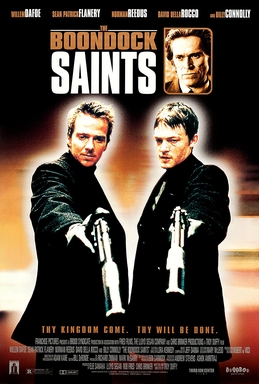
When I first saw The Boondock Saints it was before Boston had become particularly popular for shooting TV and film location shots (understand that most "Boston" based shows and movies are filmed in Vancouver, e.g. Fringe). It was nice to see my home town featured in movies, so I even enjoyed Blown Away back in the day. But Saints was different. It had more to say than most mob films. It was funnier than most buddy movies. It felt gritty in a way that I can't explain. Ultimately the saddest part was that it was easily the biggest film of its year, had it been marketed at all. Instead it made less than $50,000 and wasn't re-discovered by the public until it hit DVD (mine came from Canada, oddly enough, before it was released in the U.S.).
Over the years, rumors came out about a sequel. Then there was the documentary about the making of the sequel (called Overnight) in which the writer/director imploded in the way that Hollywood has a way of encouraging. I assumed it was a no-go. And then, suddenly, there was a trailer and a release date for Boondock Saints: All Saints Day. The sequel will come out this year, and from what I can see, only the replacement of Willem Dafoe (in what I feel is the funniest performance of his career) bodes ill. The brothers return. Another character returns played by Billy Connolly (if you haven't seen the film, I don't want to tell you more about his character... go see it). And the feel is very similar. True, this franchise risks becoming something between Rambo and Lethal Weapon, but I hold out hope that this cult classic will yield a sequel that's worthy of the first.
Amusing side-note: someone stuck The Lord of the Rings: The Two Towers into the movie connections on IMDB for Boondock Saints. Not even remotely true, but funny.
Subscribe to:
Posts (Atom)