Showing posts with label TV. Show all posts

Sunday, November 24, 2013

Spoiler-filled Doctor Who 50th Anniversary episode

Promo Image for the episode from SFX
Let's just jump right into it. First off, this is a massive spoiler-filled review! Do not read this if you have not seen the episode!

Everyone else gone? Okay, let me get the complaints out of the way: I think the fan service was laid on a bit too thick. I love Doctor Who, but man, this made even me cringe at times! There was no real reason for the Doctor to marry the queen. Having Baker appear was kind of strained (though, see below) and I thought the epilogue was kind of painful.

That's really it. I have no other complaints.

The rest of the episode was excellent.

Thursday, October 3, 2013

How to watch Star Trek

By Aaron Sherman

A while back, I did an essay about Babylon 5 that was primarily a guide for those who had never seen the show. I feel that watching it start-to-end is a bit of a mistake at this point, and there are places where you really should take a break and review what you've seen.

Star Trek isn't the same sort of thing. Star Trek is more of a mythology than a story, and as such you can pretty much jump in anywhere and enjoy it. That being said, I have definite opinions on how you might go about this. I recently put part of this together for a Google Plus response to someone who had never watched the series, so here it is (a bit expanded) for everyone:

Wednesday, February 8, 2012

How to watch Babylon 5

Babylon 5 has been off the air for over 15 years, and there's now a whole new generation of science fiction fans who probably don't know about it, and definitely haven't seen it. If you start watching it straight through, I'm afraid you won't enjoy it. So this guide is here to help you to see the show in the best possible way.

You have to understand that it's a show that was finely honed for its audience and its presentation format. It built up a following by slowly ratcheting up the amount of story being developed and then delivering big "arc" episodes that drove all of the story lines forward at once. This makes for a great series, but a slow start. Many viewers see a couple of episodes and give up, assuming the show won't go anywhere.

The FX can be distracting as well. It was aired when HD was being talked about, so the episodes were filmed in wide-screen, but the FX shots were rendered for non-HD TV and then the master data files were lost in a fire, so if you see it in HD the special effects look even more cheesy than they should, given that they were created at the dawn of the computer-rendered FX age. In addition to the purely FX shots like the exterior, the show pioneered a lot of the virtual set work that has taken over the industry. These scenes too had to be transferred over from the original broadcast masters, and could not be re-rendered. That being said, the graphics are phenomenal, given what they had to work with, and one of the draws of B5 for the "hard SF" crowd is that space combat is highly realistic. Spacecraft don't bank in B5, for example, they pivot and thrust the way they should.

First off, get over the FX and buy the first season on regular DVD or watch it online on WB's site with commercials (no, there's no Blu-Ray because to do that, they'd have to re-build every FX shot from scratch, costing millions of dollars). The guide below assumes you have at least the first season available.

I will avoid spoilers as much as I can, but I suggest keeping a bookmark to this post and not reading ahead too far as you watch the series. I'm going to walk you through the first two seasons, telling you which shows to watch and which to skip. I'll also give you a sense of when to wait a while before seeing the next. This part is important, so try to stick with me, here.


Monday, October 31, 2011

Grimm and Once Upon a Time

I've seen a fair amount said about the two shows. Obviously, this is a case of one network having gotten wind of another network's show. It's not so much "copying" that goes on as that the studios have tons of projects that have been proposed at any given time, so when they hear "modern day fairy tales" then can quickly greenlight whatever they have in the proposal stage that's similar.

The similarities aside, the two shows are radically different, and I think they'll appeal to different crowds. Grimm looks to be a police procedural with fantasy elements (Buffy the CSI Werewolf Slayer) while Once Upon a Time is more like LOST in many ways (large cast, stranded in a strange place, flashbacks) and definitely the more daring concept.

My problem with both series is that the writing is good with a few painful bumps along the way. Fantasy is hard to get right and fantasy melded into the modern day is even harder. But both Jane Espenson (Buffy: The Vampire Slayer, Battlestar Galactica, Torchwood, Once Upon a Time) and David Greenwalt (Buffy: The Vampire Slayer, Angel, Grimm) are alumni of the genre, so I expect that they'll both bring what they have to bear over the long run.

I've heard people ask, "where is Once going to go once everyone remembers," but that doesn't concern me. A few things to keep in mind: while the major first-season villain is likely the Evil Queen (Lana Parrilla), I very much doubt that she will end up being the "big bad" for the series as a whole. Right now, my money is on that being Mr. Gold (Robert Carlyle) or perhaps whoever he's working for...

Grimm is also setting up quite an interesting set of villains. Without spoiling things too much (as there are some heavy spoilers to be had) the villain that is introduced at the end of the pilot will obviously put a spin on the series. I imagine that villain is going to be a one-to-two season focus and then they plan to broaden the scope of our hero's "hunting".

I'm probably going to stick with Once for now, but I'll come back and check out Grimm once the DVDs are out.

Tuesday, May 25, 2010

Lost: What the !@#& was going on?!

Lost's pilot episode pulled me in. It was one of the best television shows I'd ever seen. The writing was brilliant, the actors were not only excellent, but all clearly gave everything they had (with one or two exceptions, but I'm able to ignore than in an ensemble cast). By the second season, the show had ground to a halt, and I became bored. I'd also been burned by Alias, Abrams' previous creation, and was not eager to be strung along for season after season again. I stopped watching late in the second season, and didn't come back until the fifth. The fourth and fifth seasons definitely picked up the pace of the show, but I was left wondering how much of what was going on would be revealed. The show was clearly set on a very cosmic trajectory, and to play that out would risk alienating a large percentage of the viewship (no matter how you play out a cosmic ending, it always alienates someone who feels that your story conflicts with their beliefs).

So, it was with trepidation that I approached the sixth season, and in fact in the final two and a half hour movie, they never did play out the larger back-story. This post is aimed at exploring what was actually going on and whether, speculation aside, we had enough information to understand what it was that was going on. This will involve spoilers for the entire series. If you haven't watched the final seasons, I suggest you do, but go in expecting a non-reveal. I liked the last episode, but I felt the way I felt at the end of Donnie Darko: clearly someone knew where they wanted to go with this, but decided they didn't have the time, creative freedom or desire to follow through. In the case of DD, the story played out in supplemental materials on the Web. In the case of Lost, I think the creators simply don't want to explain what they feel they've sufficiently hinted at, for fear of losing the sense of mystery.

OK, so let's see if we can extract reason from this show. There is really only one unanswered question of merit: what is the island? The other questions ("what are the numbers," "why do pregnant women die, etc." are secondary to this central theme and may not have answers outside of fan speculation).

Thursday, March 4, 2010

Avatar: The Last Airbender

When I started seeing ads for the Avatar: The Last Airbender movie from M. Night Shyamalan, I was a bit surprised. All I knew of the animated TV series was that it was on Nickelodeon and everyone knows that there are two kinds of shows on that network: drivel aimed at keeping kids quiet while their parents do something else and shows that get canceled fast (c.f. Invader Zim). Throw in the confusion caused by the James Cameron movie, Avatar, which had nothing to do with the show, and I just needed to watch a bit of it to get the facts straight.

So, with every expectation of hating it, I watched the first season on Netfix via their TiVo instant-watch player. I was hooked.

To be sure, it's a kid's show. The characters are mostly children; the stories tend to be simple morality plays; and there's all the cute animals you could want (or orders of magnitude more if you're like me). So why did I like it? For starters, it's a solid story that's well written and that always draws me in. For another, the story isn't your average U.S. fare.

Let me describe the outline (spoiler-free), first. The story takes place in a fantasy world where four nations represent the four alchemical elements of fire, air, water and earth. This is not merely symbolic. There's a sort of shamanistic magic called "bending" in this world, by which people can manipulate these elements (the Fire Nation's benders can manipulate fire, and so on). These nations are currently at war and the only one that can end the war is Aang, the Avatar. An Avatar is born to each generation and has the ability to manipulate all four elements, but the current Avatar is 100 years late and a child who hasn't been trained in anything but the art of air bending.

The tale goes pretty much where you'd expect: he seeks out masters of the other three arts to train him and encounters friends and adventures along the way. Standard children's fantasy. Except...

What I didn't expect was a story about the nature of personal transformation and the acceptance of responsibility for one's own destiny. The story explains, in the basic terms of a show aimed mostly at children, many of the Eastern traditions of energy manipulation and meditation along with reincarnation, karma and some anti-totalitarian politics for good measure. It's a bit like the Promethea comic, but aimed at a younger generation and with far less sex.

I strongly suggest seeing the original before M. Night takes a swing at it. Even if his movie is excellent, I really don't think you'll want to watch the series after the movie, just because it's such an investment of time.

We're just about to start the third season and can't wait to find out what happens to our now favorite characters.

Tuesday, October 27, 2009

Dollhouse and Stargate: Universe Have Best Episodes of Season


This week's SG:U and Dollhouse were easily the best episodes of the current season so far. Dollhouse is in its second season, while Stargate is just starting off, but they've both had weak seasons so far. In the case of Dollhouse, they have had to cut back their budget due to ratings last season, and have some ground to cover from a DVD-only episode. Stargate just seems to have come out of the gate at a trot, and I'm not sure why. Perhaps it's part of their LOST-like model, but in my opinion, it was a mistake that's hopefully behind. (more...)

Wednesday, July 15, 2009

Dollhouse Season 1 Review

Update': I now have a review of the extras from the season 1 DVD up.

Update: I wrote this with the target audience in mind being people who had never seen the show, and were considering it for DVD purchase. Then it hit Whedonesque ;-) So, to those who have seen the show: there are extras including the unaired epilogue episode titled "Epitaph One" on the DVD set which make it worth getting, even having seen the aired episodes.


Now that the Dollhouse: Season One DVDs are about to come out, I feel it's the right time to post a review. If you haven't been watching the show, this is Joss Whedon's latest series. He's the creator of Buffy: The Vampire Slayer and Firefly (which became the film, Serenity) among other work. He's earned a reputation among the science fiction and fantasy fandom world as a "geek's geek" who can bring humor and drama to mainstream television without watering either down. He's also a fan of tackling hard problems. He started with the unlikely heroine: the quintessential stereotype blond cheerleader, put her in a dark alley with a scary monster and... watched her wipe the floor with it's creepy carcass. In Firefly, he tackled the western in space... a hard sell by any measure.
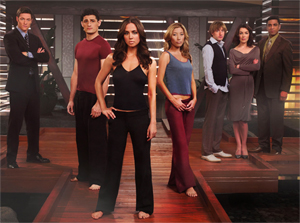
Now comes Dollhouse. This show's premise is simple: there are a group of people who have figured out how to replace someone's memories and personality including complex skills like fighting or hostage negotiation. They then "zombify" supposedly volunteer subjects, give them a blank slate for five years (or so they say) and periodically rent them out on assignment to the rich and powerful for everything from sexual encounters to something akin to special forces operations. It's all a matter of what you want or need and what you can pay for.

Needless to say, this is a tough subject. It's pretty hard to sell protagonists who work for a slavery ring that rents men and women out as mindless slaves. Of course, some in the Dollhouse aren't very likable. Some are, and this leaves you wondering why they're willing to do what they do. But ultimately it all comes down to the dolls themselves, and the show stands or falls on the shoulders of its main character played by Eliza Dushku: Echo. She's a doll, and she's not quite right... she's starting to wake up from her technologically induced stupor that the dolls are put into between assignments. Gradually, throughout the season you get more and more of a sense of who the real "Echo" is, and what she's going to want to accomplish.

The other characters aren't throw-aways. There's Topher (Fran Kranz), the genius behind the process that creates the dolls and gives them the memories and abilities they need for assignments. He's a bit of an odd character. Of all of the members of the Dollhouse, he's the one you might expect to be bothered by what they do, but he seems to be too enthused with the technology to realize what he's actually doing. In short, he's a tragic character, and I'm sure that in future seasons, he's going to have to make some hard choices.

Next up is the FBI agent, Paul Ballard (Tahmoh Penikett), whose career is on the rocks because he won't give up on the Dollhouse, which he alone believes exists. His arc is complicated, and I can't get into it without spoilers, but suffice to say that he's our Window into what the Dollhouse really is and why it exists. As he learns more, so do we.

I could analyze all of the supporting characters, but suffice to say that they all do excellent jobs, and each and every one of them deserve to be on the show.

So, is it worth buying the season one DVDs? Yes, I believe it is. This show has a lot going for it: rich plot, witty dialogue and a cast that just keeps on giving. It's also been renewed for a second, though lower-budget, season that I have high hopes for.

For his part, Whedon has said that the show definitely is going somewhere. It's not just an episodic excuse to explore the whims of the rich and powerful. Certainly such was not the case with the first season, but he seems to be implying that the series has a much more complicated story to tell. Here's hoping it's as rewarding as the first season!

Thursday, April 23, 2009

Caprica or How To Apologize To Your Fan Base


I just watched the DVD released pilot for Battlestar Galactica's prequel series, Caprica. Now, I have to get out of the way fairly quickly that I was disappointed with BSG's finale. It was a good conclusion to some of the story, but it left us wondering about some very serious details, and that felt kind of like a cop-out.

Caprica, however, is very nearly the opposite. It doesn't have a story yet, other than some history we've been told in BSG. It happens 58 years before the cylon attack on the colonies ("The Fall" as it's refered to in the opening of the pilot) and focuses pretty strongly on the creation of the "toaster" style cylons (the ones that look like they're from the original series). Where BSG's finale felt like a grudging conclusion with so much left unanswered, I think Caprica manages to answer more questions in its two hours than it asks (unusual for a pilot). By the end you will know something more about cylons, Capricans, Taurons, the Adamas (I'd consider using that name a spoiler if it weren't all over the previews SciFi has been showing), God, gods, and a great deal about the state of technology in the pre-Fall colonies.

Some things that struck me about the pilot include the increased discussion of both the monotheistic cylon religion and the polytheistic human religion. One character even attends a religious prep school based on Athena. There's some stark cultural lines too. Taurons, it turns out, are even more severly discriminated against than BSG hinted. They're called dirt eaters rather openly, and are widely assumed to be part of organized crime. The Taurons we see appear to have a combination of Eastern European Jewish and mid-20th century Italian culture with just a dash of what feels to me like late-20th century Irish. The Capricans, on the other hand are a very Western European, late 20th century urban culture. This makes for some excellent visual and cultural contrast that I'm sure will play out further in the series. Caprica itself appears to be at the cusp of decadence with the new generation of teens leading the way. This, in turn, gives the writers the opportunity to use the adults as a proxy for the viewer in being introduced to these new forms of decadence that are currently only underground.

Before I get into spoilers, let me sum up by saying that this is the DVD to buy. There are many scenes that simply can't be shown on TV, and will obviously have to be re-shot (probably were on day one) for television, so do see this version if you get the chance.

OK, now let's talk SPOILERS...

The central plot revolves around Zoe's creation of a lifelike avatar that's based on public and private records of her life, ranging from medical tests to news articles. This artificial intelligence appears to be unique, and while it's not said explicitly in the show, I think the suggestion here is akin to the mid-90s concept that AI isn't about programming, but a deeper emergent phenomenon that might require more physics than we currently have worked out to understand. That is, humans in Caprica haven't been able to create an AI, even given their very advanced computer tech. Zoe doesn't really create one either, we're told. She's just made a search engine that does a really great job of faking it. How true that is remains to be seen. Certainly the avatar Zoe seems to think she's quite real.

It's so good, in fact that it and a new fancy processor are the last steps required to create the first cylon. Just one problem: this cylon'd personality is a member of an obscure, fanatical religious sect that believes in one true god... oh and it's a teenage girl. In fact, there's a fascinating parallel to be made between Zoe-as-cylon and Cameron from Terminator: The Sarah Connor Chronicles. Where that machine is a cold and calculating device that emulates a teenage girl on the outside, this cylon is a cold, hard metal Frankenstein's monster on the outside with the soul of a teenage girl. An interesting reversal that makes me wonder how conscious it was.

There are four organizations involved so far. We have the military-industrial complex represented by Graystone; law enforcement represented by Jordan Duram who is looking into the attack that killed Zoe; the religious fanatics are headed up by Zoe's former teacher; and finally, we have organized crime represented by the Adamas and their contacts with the Tauron Halafa. This web of power is likely to become the fulcrum on which the plot of the series pivots. I don't get the sense that the Soldiers of the One (the monotheist extremists) will be around all that long. Certainly, they're no longer an issue in BSG, and while it is now clear that they are where the cylons got monotheism from (remember BSG established that it was the centurions who brought monotheism to the them, but we never knew where the centurions got it), that loop has already been closed by Zoe. We'll see, but I'd like to think the plot will develop beyond BSG's monotheism-driven faction vs. polytheism-driven faction. Ideally I'd like to see a more nuanced story than that, and I think Moore's desire to make Caprica its own show will drive it in that direction.

So that's Caprica. Sadly we now have to wait an indefinitely long time for the actual series, but on the bright side, the pilot was actually good enough to make me anticipate that with some eagerness.