Showing posts with label political science. Show all posts

Tuesday, September 4, 2012

Digging into politics: the political spectrum

One (U.S.) view of the political spectrum.
Politics is complicated, I'll grant, but the rampant misunderstanding of what the political spectrum actually looks like is often frustrating to me. First off, unlike the visual spectrum, it's not a line of various shades of color stretching from conservative to liberal, as many Americans seem to think. Instead, it's actually an incredibly complicated star with dozens of end-points. In this essay, I'm just going to touch on one aspect of it: how people view the function of government.

Imagine that you asked thousands of people to complete the sentence, "the government should exist to provide..." Like the old game show, we can imagine taking the top four answers to this question and laying them out in a grid. The most common  answers would probably be variations on, "benefit to society," "corporate liberty," "benefit to the individual," and "individual liberty." At their heart these describe who you think government should provide benefits to and who you think government should protect the rights of. As it turns out, while Democrats and Republicans would like to paint each other as enemies of individual liberty, both parties favor a balance between corporate and individual liberties. On the other hand, the traditional liberal position slides further out toward individual liberty.

Thursday, August 23, 2012

What are Instant Runoff Voting and Approval Voting?

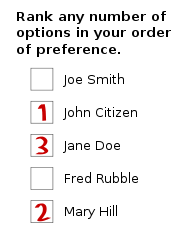
Voting is actually a very complex topic within political science and applied mathematics, but let me introduce you to the simplest form of two of the most popular alternative voting systems in the world: Instant-Runoff Voting (IRV) and Approval Voting (AV).

Both systems seek to solve a simple problem with the system that the United States (and most nations) currently use, which is called Plurality Voting (PV). That problem is that PV forces voters into two opposed camps, each camp taking one candidate as their "champion". This results in what often turns out to be a maximum of unhappy voters. For example, if you place people's views on a scale from 1 to 10 with 1 being the most liberal and 10 being the most conservative, PV tends to foster candidates that fall around the 2-4 and 7-9 range However, if your goal is to elect someone who represents the majority of Americans, it would certainly make much more sense to elect someone that falls into the 4-7 range and let the end-points tug that center-line back and forth. The problem is that centrists are essentially blocked out of PV systems because they are seen as "spoilers" for the extremes.