Judge Kavanaugh is currently in the process of being confirmed for the United States Supreme Court. He stands accused of some horrific behavior, which it is neither the job of the US Senate to try nor convict. It is, however, their role to advise and consent over the nomination of this candidate, and to that end, they should always demand all of the facts.
As a conservative, I value the status quo. I value established procedure and working systems of governance. In this case, that means valuing the time-honored process by which we deal with new information during a confirmation process: we re-open the FBI background investigation and take the results of the expanded background check into account during the remaining confirmation process. This is not a Democratic or Republican process, it is the process of the United States Senate.
Yet we are told that such an investigation is not necessary, that it is a stalling tactic, that it is not what the FBI does (!) and that it can not and will not be employed now. Here's the fact of the matter: there is a mid-term election looming. The Democrats want to delay the vote on Kavanaugh until after the election. Republicans want to ram the vote through before the election. Neither one should have their way. The process isn't new or contrived. The process has its own pace, and if it takes longer than Republicans would like or ends sooner than Democrats would like, that's not relevant. What's relevant is that, when we look back at this in several years, we see a thoughtful, respectful and thorough process that confirmed or failed to confirm a Judge to the Supreme Court with all due consideration.
I don't feel that that's what we're getting, and that concerns me as a conservative. I think it should concern you as an American.
Showing posts with label politics. Show all posts
Showing posts with label politics. Show all posts
Friday, September 28, 2018


Wednesday, October 9, 2013
Obama is not remotely the worst President in US history
By Aaron Sherman
Today, I came across another one of those silly, "Obama is the worst President ever!" claims that you see floating around poorly spelled Facebook posts or Fox News. Usually I brush it off, but tonight I thought it needed a real response. Let me be clear, I'm a moderate who's not always a big fan of Obama. I don't like Obamacare (single payer models are cheaper and more effective) and I'm aghast at the expansion of domestic spying under his and W's administrations. That said, I think calling him the worst President ever is as absurd as any claim I've ever heard in the political realm, and I lived through Reagan claiming that he had no idea that Iran-Contra was going on in his administration and Nixon claiming that he wasn't a crook.
Today, I came across another one of those silly, "Obama is the worst President ever!" claims that you see floating around poorly spelled Facebook posts or Fox News. Usually I brush it off, but tonight I thought it needed a real response. Let me be clear, I'm a moderate who's not always a big fan of Obama. I don't like Obamacare (single payer models are cheaper and more effective) and I'm aghast at the expansion of domestic spying under his and W's administrations. That said, I think calling him the worst President ever is as absurd as any claim I've ever heard in the political realm, and I lived through Reagan claiming that he had no idea that Iran-Contra was going on in his administration and Nixon claiming that he wasn't a crook.
So here was my response, reviewing the past few decades of Presidents.
Thursday, July 4, 2013
Let's get over Chained CPI
By Aaron Sherman
In the United States, we tie a number of entitlements programs like Social Security to inflation. This means that as goods become more expensive, those benefits go up. This makes good sense if you want those entitlements to adapt to the economic conditions (whether or not wanting that is a good thing is beyond the scope of this article). So, you may have heard of this thing called "Chained CPI" which some politicians argue amounts to a plan to cut Social Security benefits.
That's nonsense, and just so that you know where I'm going with this, anyone who says that is lying to you. Want to find out more, or are you already plotting my death because I'm clearly one of those people? (hint: I'm not)
In the United States, we tie a number of entitlements programs like Social Security to inflation. This means that as goods become more expensive, those benefits go up. This makes good sense if you want those entitlements to adapt to the economic conditions (whether or not wanting that is a good thing is beyond the scope of this article). So, you may have heard of this thing called "Chained CPI" which some politicians argue amounts to a plan to cut Social Security benefits.
That's nonsense, and just so that you know where I'm going with this, anyone who says that is lying to you. Want to find out more, or are you already plotting my death because I'm clearly one of those people? (hint: I'm not)
Tuesday, September 4, 2012
Digging into politics: the political spectrum
| One (U.S.) view of the political spectrum. |
Imagine that you asked thousands of people to complete the sentence, "the government should exist to provide..." Like the old game show, we can imagine taking the top four answers to this question and laying them out in a grid. The most common answers would probably be variations on, "benefit to society," "corporate liberty," "benefit to the individual," and "individual liberty." At their heart these describe who you think government should provide benefits to and who you think government should protect the rights of. As it turns out, while Democrats and Republicans would like to paint each other as enemies of individual liberty, both parties favor a balance between corporate and individual liberties. On the other hand, the traditional liberal position slides further out toward individual liberty.
Thursday, August 23, 2012
What are Instant Runoff Voting and Approval Voting?
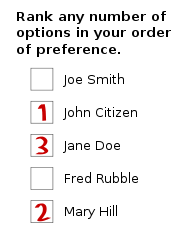
Both systems seek to solve a simple problem with the system that the United States (and most nations) currently use, which is called Plurality Voting (PV). That problem is that PV forces voters into two opposed camps, each camp taking one candidate as their "champion". This results in what often turns out to be a maximum of unhappy voters. For example, if you place people's views on a scale from 1 to 10 with 1 being the most liberal and 10 being the most conservative, PV tends to foster candidates that fall around the 2-4 and 7-9 range However, if your goal is to elect someone who represents the majority of Americans, it would certainly make much more sense to elect someone that falls into the 4-7 range and let the end-points tug that center-line back and forth. The problem is that centrists are essentially blocked out of PV systems because they are seen as "spoilers" for the extremes.
Tuesday, July 10, 2012
The Audacity of Change: Obama's Healthcare Gambit
Starting in the late 1980s and early 1990s, I began to hear an increasingly alarmed cry from certain political sectors about the fate of healthcare. As early as 1987, health care costs rose from #15 to #7 in the list of Americans' top worries about the future and that only got worse. As the '90s wore on and into the '00s, I continued to hear two things:
In 1993 and 1994 the Bill Clinton administration attempted to push the Health Security Act through congress. This was a true overhaul of health care in the United States, which provided for a set of regional health care alliances which managed the interaction between health insurance providers and consumers. It avoided the controversial "mandate" of Obama's plan by making health care premiums a tax which funded regional alliances.
- Because of the baby-boom, health care and retirement programs were going to run out of money.
- Because doing anything about it was complicated and fraught with risk, no politician was going to do anything about it until it was too late.
In 1993 and 1994 the Bill Clinton administration attempted to push the Health Security Act through congress. This was a true overhaul of health care in the United States, which provided for a set of regional health care alliances which managed the interaction between health insurance providers and consumers. It avoided the controversial "mandate" of Obama's plan by making health care premiums a tax which funded regional alliances.
Tuesday, January 31, 2012
I shouldn't be tracked by Google: A modest proposal
Google shouldn't track my behavior. That's a simple enough concept, but that seems to have been lost in recent days with the publication of their new privacy policy. Why is it that they can't keep their hands off of my data?
Well, I mean, I want them to manage my email, sure. That data they should manage, but they shouldn't read it. I mean, they should read it in order to format it, spam-filter it, check it for phishing links and invalid from-addresses. They should also read the attachments so that they can present me with easy ways of downloading or displaying them as needed. Oh and they should present contacts that are mailed to me in useful ways and allow me to import them into my contacts list. But they shouldn't be reading my mail, you know? Like for advertising. I know I could pay money and get a no-ads version of gmail through Google Apps, but I don't want to pay for it, I just want random ads for political candidates from other countries and arthritis medication instead of things I'm interested in. You know... because Google shouldn't be reading my mail.
And they definitely shouldn't be coordinating across their platforms. I mean sure, they should read all of my texts and instant messages so that I can easily index them along with my mail and search through the whole thing at once. I'd really like more features for adding tags to text messages through Google Voice too. But I just don't want them to read that stuff. You know, because it's ... icky.
Also, I'd like Google to stop sharing my private data with other companies. OK, I know they don't do that, but let's say they did. That'd be pretty annoying, right? See? Right, there. Google is doing annoying things to us! Google says their corporate motto is "don't be evil" (actually, it's part of the S1 filing with the SEC, a sort of proviso to potential stock holders that they'll do things like pull out of China if they feel they can't provide a helpful service without propping up the state system of censorship, but that's sort of the same thing, right?) But I think they are evil because they unified their privacy policy and say that their various products will share information. I mean, sharing my information is bad, right? Well, except that I do want it all to be available in ways that make sense. I mean, Google+ should definitely read my contacts and Google Calendar should be integrated with Google+ to allow Google Pages companies to share corporate events calendars. I'd also like to be able to share my free/busy time with circles. I just don't want that other kind of sharing ... because it's icky.
OK, I'll admit it, I don't really know what it is that I'm worried about. Yeah, Google gives me more choice, control and ability to take my data out of their services than anyone else. Sure, they champion the use of open standards that make the Internet a playground for entrepreneurs and technophiles alike. And I have to admit that they've fostered a boom in open source software development that has taken systems like Linux into the hands of millions of people. But none of that changes the fact that I'm kind of scared about a nebulous evil that I expect to be creeping around the door any second now.
Good thing Congress is getting involved. You don't see Facebook sharing ... well OK. But you don't see Yahoo distributing user information across ... well OK. But you don't see Cisco coordinating with the Federal ... Hmm. Well, it's just scary!
Friday, October 28, 2011
Obamacare has to go
I think most Americans will agree with me that Obamacare needs to go. It's a dangerous and uncertain plan that looms over American businesses at a time when this country needs growth in order to extract itself from a terrible financial crisis. However, I also think that the majority of Americans understand that the status quo in healthcare isn't working, and we need to fix it. Thankfully, we don't need anything as radical as Obamacare in order to fix it.
The problem with our current health care system is that it pretends not to be a universal health care solution, but it actually tries to function as one. Medicare acts as a catch-all, paying for those who cannot afford health care when they are brought to an emergency room. Sounds reasonable, since that's a life-or-death decision, but in reality, people who can't afford coverage wait until their conditions are life threatening, and then the go to the emergency room, there to be covered by Medicare. They don't do this because they want to live off of the public dole, but because it's the only option they have.
So we end up paying far more in emergency room expenses than we would otherwise (vastly more) because these patients can't afford the cheaper coverage before hand that would let them see an out-patient doctor for an infection or broken bone.
Obamacare tries to patch this up by intruding into people's lives with a giant government plan. Instead, what we need is to involve the free market. Open up options to people to allow them to subscribe to the plan of their choice where they can afford it and to provide some kind of market-sourced solution, not a giant government bureaucracy, when they can't. To help individuals to work together to get costs down, we can leverage employers by having larger employers who can already afford insurance, subscribe to the plan of their choice from the provider of their choice. Again, the market will solve an awful lot of these problems for us.
For smaller employers, we need to remain hands-off so that they have the chance to grow and flourish to become the Googles or the Amazons of tomorrow!
There are some other concerns. No matter what side of the abortion issue you're on, I think it's fair to say that Americans are divided enough that our national health care strategy should't go to pay for it. Resolving contentious issues should never be done through giant bureaucracies!
Also, the existing Medicare system should be modified to work more closely with this new, market-driven plan. That allows the government to save a substantial amount of money on Medicare and transition those services to the lower-overhead system.
To everyone who's giving me an "amen" on this anti-Obamacare rant, I'd just like to say one thing: I kind of lied. The above is a description of the Obama Health Care Plan. All of the cries of "uncertainty" and "government takeover of health care" are basically just a smoke screen to prevent you from thinking rationally about what is really the only rational solution for a country that is so heavily invested in the idea of the free market. If that were not the case, we could cut costs and improve quality of care by going to a Canadian or British single-payer model, but there's no sense pushing such a model in the U.S. right now.
The limitation of the Obama plan is that it doesn't really address many of the outstanding issues with Medicare and Medicaid coverage, but that makes it an incomplete plan, not a useless one.
If you want to understand the Obamacare plan better, and really have a handle on where it does and doesn't live up to what we should expect, see my previous article about the bill before it became law.
The problem with our current health care system is that it pretends not to be a universal health care solution, but it actually tries to function as one. Medicare acts as a catch-all, paying for those who cannot afford health care when they are brought to an emergency room. Sounds reasonable, since that's a life-or-death decision, but in reality, people who can't afford coverage wait until their conditions are life threatening, and then the go to the emergency room, there to be covered by Medicare. They don't do this because they want to live off of the public dole, but because it's the only option they have.
So we end up paying far more in emergency room expenses than we would otherwise (vastly more) because these patients can't afford the cheaper coverage before hand that would let them see an out-patient doctor for an infection or broken bone.
Obamacare tries to patch this up by intruding into people's lives with a giant government plan. Instead, what we need is to involve the free market. Open up options to people to allow them to subscribe to the plan of their choice where they can afford it and to provide some kind of market-sourced solution, not a giant government bureaucracy, when they can't. To help individuals to work together to get costs down, we can leverage employers by having larger employers who can already afford insurance, subscribe to the plan of their choice from the provider of their choice. Again, the market will solve an awful lot of these problems for us.
For smaller employers, we need to remain hands-off so that they have the chance to grow and flourish to become the Googles or the Amazons of tomorrow!
There are some other concerns. No matter what side of the abortion issue you're on, I think it's fair to say that Americans are divided enough that our national health care strategy should't go to pay for it. Resolving contentious issues should never be done through giant bureaucracies!
Also, the existing Medicare system should be modified to work more closely with this new, market-driven plan. That allows the government to save a substantial amount of money on Medicare and transition those services to the lower-overhead system.
To everyone who's giving me an "amen" on this anti-Obamacare rant, I'd just like to say one thing: I kind of lied. The above is a description of the Obama Health Care Plan. All of the cries of "uncertainty" and "government takeover of health care" are basically just a smoke screen to prevent you from thinking rationally about what is really the only rational solution for a country that is so heavily invested in the idea of the free market. If that were not the case, we could cut costs and improve quality of care by going to a Canadian or British single-payer model, but there's no sense pushing such a model in the U.S. right now.
The limitation of the Obama plan is that it doesn't really address many of the outstanding issues with Medicare and Medicaid coverage, but that makes it an incomplete plan, not a useless one.
If you want to understand the Obamacare plan better, and really have a handle on where it does and doesn't live up to what we should expect, see my previous article about the bill before it became law.
Wednesday, October 19, 2011
Oil and Gold: What will the end of fossil fuels bring?
I just came across Charles Stross's posting about the end of fossil fuels boding the end of space exploration (or at least a massive slowdown).
I have to disagree, but the topic brought up a lot more thinking about fuel and our economy than it did about space, at least for me. The man he's quoting calls the end of fossil fuels an, "unprecedented transition," but of course, it's not. Our original fuel (and building!) material of choice was wood. When wood ran out (understand that when we talk about a resource "running out," we mean that it became difficult enough to use that it was no longer the ideal source) we moved on to a combination of iron and oil. Interestingly enough, this lead to a massive explosion in both out economy and technological growth. One could argue that if wood were a much more rapidly replenished resource, we might not have had a space race, or at least it might have come much later.
So, what will the end of fossil fuels bring? We can't really know, but one thing it won't bring is the end of our desire to expand, learn and explore. Will that be in space, or will we decide to go to the bottom of the oceans or into the Earth's crust first? I don't know. We have a lot of 3-dimensional territory to explore and exploit. What I do know is that running out of oil will be a fast process when viewed in the long term, but probably slow enough that we'll transition to something new, just as we did before.
I have to disagree, but the topic brought up a lot more thinking about fuel and our economy than it did about space, at least for me. The man he's quoting calls the end of fossil fuels an, "unprecedented transition," but of course, it's not. Our original fuel (and building!) material of choice was wood. When wood ran out (understand that when we talk about a resource "running out," we mean that it became difficult enough to use that it was no longer the ideal source) we moved on to a combination of iron and oil. Interestingly enough, this lead to a massive explosion in both out economy and technological growth. One could argue that if wood were a much more rapidly replenished resource, we might not have had a space race, or at least it might have come much later.
So, what will the end of fossil fuels bring? We can't really know, but one thing it won't bring is the end of our desire to expand, learn and explore. Will that be in space, or will we decide to go to the bottom of the oceans or into the Earth's crust first? I don't know. We have a lot of 3-dimensional territory to explore and exploit. What I do know is that running out of oil will be a fast process when viewed in the long term, but probably slow enough that we'll transition to something new, just as we did before.
Monday, August 8, 2011
The Tea Party Recession
So, phrases like "there is a lot of forced liquidation" and "it's only one rating agency; if others follow that would be a bigger problem," (from The Wall Street Journal) are making me grind my teeth today. This is not because the economy is breaking in a fundamental way that we have not seen in my lifetime, but because, and I say this with a fondness for conservatism as an ideal, this entire fiasco is a politically manufactured event that resulted from, as Sen. McConnell put it, placing the number one priority on making sure Obama is a one-term President. I'm not saying the Republicans wanted to trigger a depression, which we might be on track for, now; but I am saying that you don't set a political goal as priority number one as the country slowly extracts itself from a recession.
Let me also be clear that I wasn't entirely against the idea of using the debt ceiling as a wedge. We've known for over a decade now that we needed to control certain elements of our spending that were out of control, and instead of controlling that spending we increased it over the last 10 years and instituted a series of deep revenue cuts which magnified the problem. Then, when recession hit, we spent our way out of it, further rubbing salt in the wound. We needed a political wedge, but when a reasonable plan, or at least an excellent start to one was worked up by Boehner and Obama, that should have been where we planted the flag. Yes, we still needed more work, but it was the first time I'd heard someone admit that we needed "both parties taking on their sacred cows." That quote is from Obama's address to the nation. Boehner was, at one point, willing to discuss such a radical plan, not because it was good politics for either party, but because it was good governing and the kind of compromise that benefits the nation.
The Tea Party, however, forced his hand. A compromise could be seen as Obama "winning," and first-term Tea Party Republicans would almost certainly be in jeopardy in their first re-election bids. They would never sign on to such a deal.
Revenues were a sore point because many had signed oaths that they would not raise taxes, and even closing tax loopholes was seen as a violation of that pledge, regardless of the fact that massive tax cuts constituted a defacto increase in spending which it was impossible to account for without pillaging critical services.
Now, we have S&P saying that Washington's unwillingness to address revenue shortfalls was central to their downgrading U.S. debt. I've addressed, previously, why such a move was disastrous and why it was critical that we avoid it. Yet, here we are. The Tea Party and revenue oaths brought us here, and there's no contingency plan. In a decade or two, we'll recover from this. We might see very hard times until then, but we'll recover. Americans are resilient in the face of adversity, but I just wish we hadn't been forced into that adversity in the first place.
I'm a moderate who really lives on the Democratic side only by virtue of a handful of social issues. And yet, here I am: forced to view the current batch of Republicans as, quite literally, the enemies of the value of my currency. I would really like them to think about that, but I doubt it's going to happen.
There's a pattern to the Obama Presidency. Health care legislation was an omen. Obama compromised deeply out of the gate, scuttling the plan for a single-payer system on-par with Canada or the U.K., where health care costs are around half of what we spend in the U.S., per capita, for far less coverage. Instead, he proposed an extremely conservative, market-driven, insurance-based approach where existing insurance companies would control most of the system (for an excellent, point-by-point rundown of the health care legislation, see PBS's breakdown, which I've discussed previously in early 2010). So, what did conservatives, knowing that health care is actively bankrupting the U.S., do in response? They pledged to repeal this icon of socialism (!), with no alternative plan for the future of health care in the U.S., which would return us to a state where we would be the only wealthy nation that didn't have a comprehensive approach to health care.
The pattern is that Obama tries to compromise, but the goal of his opposition isn't legislative. Whatever line he draws in the sand, no matter how deep into conservative territory it is, that is the battle line, and Republicans are not allowed to cross it, even if they would have done so before Obama got there. That's not governing. That's not even effective politics. It's just mindless antagonism.
As a result, there's only one thing to call the resulting recession (or depression or whatever this becomes): The Tea Party Recession. This is the outcome that the Tea Party fought for. This is the tearing down of the status quo that they desired. It might well achieve the goal of Obama being a one-term President. We might end up with President Romney (essentially the architect of the heath care plan we ended up with) as a result. But ultimately, this economic result must be the sign that they carry along side their other political slogans. They need to own this result because they fought for it.
As a side note, we're not going to solve this problem until we reform voting in the U.S. Plurality voting (where everyone gets to vote for one option and the largest number of votes for any one option wins) is broken. It's been demonstrated mathematically and in practice that it forces a two-party system. If we want to get away from polarizing politics, we need strong parties that represent the spectrum of views held throughout America. We need to dump our polarizing voting system and institute something like an approval voting system (where everyone votes for every option they like, and the largest number of votes for any one option wins). There are other options to be sure (from Instant Runoff Voting to much more esoteric systems), but which option we choose isn't the concern. Changing the voting system is not a solution, but it's the right first step. If we did that, the Tea Party would be a vocal fringe that the Republicans wouldn't be saddled with. There would actually be a Socialist Party on the left, and compromising with centrist Democrats wouldn't be seen as a slippery slope toward the far-left, because there's a political buffer there.
The next step, of course, is to change the way we seat members of Congress, but a more party-representation model is probably not going to be helpful until we first address voting.
So... can we start working on this? Can we move the ball forward now that the current system has been proven poisonous?
Let me also be clear that I wasn't entirely against the idea of using the debt ceiling as a wedge. We've known for over a decade now that we needed to control certain elements of our spending that were out of control, and instead of controlling that spending we increased it over the last 10 years and instituted a series of deep revenue cuts which magnified the problem. Then, when recession hit, we spent our way out of it, further rubbing salt in the wound. We needed a political wedge, but when a reasonable plan, or at least an excellent start to one was worked up by Boehner and Obama, that should have been where we planted the flag. Yes, we still needed more work, but it was the first time I'd heard someone admit that we needed "both parties taking on their sacred cows." That quote is from Obama's address to the nation. Boehner was, at one point, willing to discuss such a radical plan, not because it was good politics for either party, but because it was good governing and the kind of compromise that benefits the nation.
The Tea Party, however, forced his hand. A compromise could be seen as Obama "winning," and first-term Tea Party Republicans would almost certainly be in jeopardy in their first re-election bids. They would never sign on to such a deal.
Revenues were a sore point because many had signed oaths that they would not raise taxes, and even closing tax loopholes was seen as a violation of that pledge, regardless of the fact that massive tax cuts constituted a defacto increase in spending which it was impossible to account for without pillaging critical services.
Now, we have S&P saying that Washington's unwillingness to address revenue shortfalls was central to their downgrading U.S. debt. I've addressed, previously, why such a move was disastrous and why it was critical that we avoid it. Yet, here we are. The Tea Party and revenue oaths brought us here, and there's no contingency plan. In a decade or two, we'll recover from this. We might see very hard times until then, but we'll recover. Americans are resilient in the face of adversity, but I just wish we hadn't been forced into that adversity in the first place.
I'm a moderate who really lives on the Democratic side only by virtue of a handful of social issues. And yet, here I am: forced to view the current batch of Republicans as, quite literally, the enemies of the value of my currency. I would really like them to think about that, but I doubt it's going to happen.
There's a pattern to the Obama Presidency. Health care legislation was an omen. Obama compromised deeply out of the gate, scuttling the plan for a single-payer system on-par with Canada or the U.K., where health care costs are around half of what we spend in the U.S., per capita, for far less coverage. Instead, he proposed an extremely conservative, market-driven, insurance-based approach where existing insurance companies would control most of the system (for an excellent, point-by-point rundown of the health care legislation, see PBS's breakdown, which I've discussed previously in early 2010). So, what did conservatives, knowing that health care is actively bankrupting the U.S., do in response? They pledged to repeal this icon of socialism (!), with no alternative plan for the future of health care in the U.S., which would return us to a state where we would be the only wealthy nation that didn't have a comprehensive approach to health care.
The pattern is that Obama tries to compromise, but the goal of his opposition isn't legislative. Whatever line he draws in the sand, no matter how deep into conservative territory it is, that is the battle line, and Republicans are not allowed to cross it, even if they would have done so before Obama got there. That's not governing. That's not even effective politics. It's just mindless antagonism.
As a result, there's only one thing to call the resulting recession (or depression or whatever this becomes): The Tea Party Recession. This is the outcome that the Tea Party fought for. This is the tearing down of the status quo that they desired. It might well achieve the goal of Obama being a one-term President. We might end up with President Romney (essentially the architect of the heath care plan we ended up with) as a result. But ultimately, this economic result must be the sign that they carry along side their other political slogans. They need to own this result because they fought for it.
As a side note, we're not going to solve this problem until we reform voting in the U.S. Plurality voting (where everyone gets to vote for one option and the largest number of votes for any one option wins) is broken. It's been demonstrated mathematically and in practice that it forces a two-party system. If we want to get away from polarizing politics, we need strong parties that represent the spectrum of views held throughout America. We need to dump our polarizing voting system and institute something like an approval voting system (where everyone votes for every option they like, and the largest number of votes for any one option wins). There are other options to be sure (from Instant Runoff Voting to much more esoteric systems), but which option we choose isn't the concern. Changing the voting system is not a solution, but it's the right first step. If we did that, the Tea Party would be a vocal fringe that the Republicans wouldn't be saddled with. There would actually be a Socialist Party on the left, and compromising with centrist Democrats wouldn't be seen as a slippery slope toward the far-left, because there's a political buffer there.
The next step, of course, is to change the way we seat members of Congress, but a more party-representation model is probably not going to be helpful until we first address voting.
So... can we start working on this? Can we move the ball forward now that the current system has been proven poisonous?
Monday, August 1, 2011
Budget Control Act 2011: A quick read (part 1)
Here's some points that come immediately to mind on reading the text of the compromise bill that's being pushed to end the debt ceiling fiasco (for which I seriously hope there is a price to be paid for everyone in Congress who decided that political points were important enough to hold a gun to the economy over):
- SEC. 251. ENFORCING DISCRETIONARY SPENDING LIMITS. / (a) ENFORCEMENT /(1)
SEQUESTRATION: This appears to be a cut-and-paste from an existing law. - (3) MILITARY PERSONNEL: I'f I'm reading this right, the idea is that, should the president use existing authority to exceed set spending levels to pay military personnel, there's an automatic debit against all other segments of government. An interesting idea. In practice, I'm not sure how it will work.
- Then there's a lot of implementation detail including who reports the numbers to whom.
- (A) EMERGENCY APPROPRIATIONS; OVERSEAS CONTINGENCY OPERATIONS / GLOBAL WAR ON TERRORISM: This section seems to exempt budgetary items that Congress and the President agree on labeling as being for military contingencies and the "War on Terror". Which, in practice, probably means the military budget is off the table. That probably renders much of this legislation fairly toothless for anything but reducing entitlements.
- CONTINUING DISABILITY REVIEWS AND REDETERMINATIONS: It looks as if this section sets hard-caps on how much Social Security expenditures can grow by, effectively applying a tourniquet to the failure of the Social Security Trust Fund (funny story, that trust fund was already spent by forcing it to buy U.S. Bonds, so had we refused to raise the debt ceiling, and had to choose whose bonds to pay off... Social Security would have been one of the parties hoping they wouldn't get defaulted on). The hard-caps on Social Security growth are 623 million in FY 2012, 751 million in 2013, 924 million in 2014, 1.1 trillion in 2015, 1.2 trillion in 2016, 1.3 trillion in 2017, and 1.3 trillion ongoing each year through 2021. There's a similarly large amount that's specified as a cap on fraud and abuse control expenditures.
- (D) DISASTER FUNDING - This section sets some guidelines on what disaster relief is, how to measure what a reasonable amount of money to spend on it is, and exempts that amount from automatic adjustments.
- This bill says that it replaces and repeals "Section 275 of the Balanced Budget and Emergency Deficit Control Act of 1985"
- Also that, "Sections 252(d)(1), 254(c), 254(f)(3), and 254(i) of the Balanced Budget and Emergency Deficit Control Act of 1985 shall not apply to the Congressional Budget Office." That might be a formality of replacing that law, but more reading would be necessary to determine that.
- (d) EMERGENCIES IN THE HOUSE OF REPRESENTATIVES: Interestingly, this section locks in a definition of expenditure increases which includes revenue reduction (e.g. tax cuts). This is a good thing, as it's impossible to control costs without including a measure of what the available funds are and how they are constrained at the same time.
- (e) ENFORCEMENT OF DISCRETIONARY SPENDING CAPS: This section basically says, "you have to comply with these rules, or your bill can't even be debated."
- SEC. 106. SENATE BUDGET ENFORCEMENT: If I'm reading this right, the Senate Committee on the Budget needs to submit a balanced budget. So, perhaps (and I'm not 100% on this), the preceding sections deal with the laws that set out exceptional conditions under which the budget can be modified, and this section sets out the requirement that you have to start balanced?
- TITLE II—VOTE ON THE BALANCED BUDGET AMENDMENT: This section just says that there needs to be a vote in the November-December timeframe on a balanced budget amendment. The only thing that scares the daylights out of me, here, is that the "join resolution" is essentially rammed through as a matter of procedure. What does this mean? It means that no matter what the House and Senate pass titled, "Joint resolution proposing balanced budget amendment to the Constitution of the United States," a joint resolution has to be formed. In theory this is a normal part of lawmaking where the House and Senate versions are merged, but this section strips out some of the controls over how broad and sweeping that reconciliation can be, and how much control anyone has over what goes into that "compromise." In theory, nothing new can get tucked into it, but in reality, there's no real controls here, and we're talking about our Constitution! The states still need to ratify whatever mess comes out of Congress, but there's no chance to edit the Amendment after this stage.
OK, that's it for now. I'll try to digest the rest late tonight or tomorrow.
Saturday, July 16, 2011
Why defaulting isn't an option
I was in a hotel room tonight, so I found myself channel surfing, and Bill Maher was on. His guests were trying to understand the urgency of the debt ceiling crisis (a crisis that exists only because our politicians choose to make it a crisis). Several times they got confused, with one guest arguing that it didn't matter if we defaulted for a short period, because it would just trigger increased interest rates, which the Fed could just turn around and modify.
His confusion surrounds the imprecise use of the term, "interest rates." There are a lot of interest rates that the government interacts with. One of them is the prime lending rate, which is the rate at which banks loan money (it's actually a starting point which can be modified by circumstances, term, etc.) The prime lending rate is based on the rate that banks will charge each other for a loan, called the federal funds rate. This rate is currently 0-0.25%, which means that banks are essentially loaning each other money without or with very low interest, allowing prime lending rates of approximately 3.25%.
That's the number that Bill Maher's guests were talking about, but it has nothing to do with the debt ceiling crisis (at least directly). To understand why, we need to look at a second type of loan: treasury bills are IOU notes that the government writes over short periods of time. An investor buys one of these T-bills for some amount less than they are worth and in 3 to 12 months depending on the T-bill, they "mature", meaning that the government pays off the investment at its face value. So, if you bought a $1000, 3 month T-bill for $990, you would make a $10 (1%) profit in 3 months when the government paid it off.
The rate is based on a number of factors including supply (the amount the government wants to borrow) demand (the amount investors want to invest) and the risk that the note won't be paid off. In the case of the U.S. government, that risk is considered to be as near to zero as it is possible to get in the realm of investment. Because U.S. government debt is considered the standard for low-risk investment, much of the market is geared toward treating the T-bill rates as a baseline.
A change to that baseline (e.g. because of a single default) would radically change the investment landscape in a way that we can't fully know, because it's never happened before. This is because investors (not the Fed) would not be willing to buy T-bills at the same rate. So, what's wrong with a higher interest rate on our debt? Well, for starters, it means that all of our current projections for the federal deficit over the next several years would rocket up. What's more, all of the large, institutional investors (including nations) who buy U.S. debt would have to scramble to determine if it even made sense any longer, or if they should be buying someone else's debt, possibly reducing demand, and further driving up interest rates. The impact of this on the value of the dollar, inflation and other aspects of our economy is a matter for debate, but it would likely produce a shock wave through every aspect of the economy.
Ultimately, the U.S. would continue to find buyers for its debt, but not before the market had to absorb a fundamental shift in its underlying assumptions at a time when we're just coming out of a major recession. Such economic turmoil at a time like this would be very likely to trigger a return to recession or worse. It could also destabilize investment firms, causing another wave of failures. During the last wave of failures, we relied on the U.S. government's excellent credit rating to borrow funds to see us through the crisis. That, of course, would be changed this time around.
So, as you can see, the "interest rate" on T-bills is very different from the Fed-controlled federal funds rate, and the lack of concern showed on Maher's program is just the result of a misunderstanding about how much impact this process could have. I'm no economist, and I'll admit to ignorance on some of the details, here, but what's important to understand is that ignorance is the basic problem, here. We just don't know how bad this would be because it's unprecedented. We just know that it's a pretty awful idea, and there's no excuse for not paying our bills.
His confusion surrounds the imprecise use of the term, "interest rates." There are a lot of interest rates that the government interacts with. One of them is the prime lending rate, which is the rate at which banks loan money (it's actually a starting point which can be modified by circumstances, term, etc.) The prime lending rate is based on the rate that banks will charge each other for a loan, called the federal funds rate. This rate is currently 0-0.25%, which means that banks are essentially loaning each other money without or with very low interest, allowing prime lending rates of approximately 3.25%.
That's the number that Bill Maher's guests were talking about, but it has nothing to do with the debt ceiling crisis (at least directly). To understand why, we need to look at a second type of loan: treasury bills are IOU notes that the government writes over short periods of time. An investor buys one of these T-bills for some amount less than they are worth and in 3 to 12 months depending on the T-bill, they "mature", meaning that the government pays off the investment at its face value. So, if you bought a $1000, 3 month T-bill for $990, you would make a $10 (1%) profit in 3 months when the government paid it off.
The rate is based on a number of factors including supply (the amount the government wants to borrow) demand (the amount investors want to invest) and the risk that the note won't be paid off. In the case of the U.S. government, that risk is considered to be as near to zero as it is possible to get in the realm of investment. Because U.S. government debt is considered the standard for low-risk investment, much of the market is geared toward treating the T-bill rates as a baseline.
A change to that baseline (e.g. because of a single default) would radically change the investment landscape in a way that we can't fully know, because it's never happened before. This is because investors (not the Fed) would not be willing to buy T-bills at the same rate. So, what's wrong with a higher interest rate on our debt? Well, for starters, it means that all of our current projections for the federal deficit over the next several years would rocket up. What's more, all of the large, institutional investors (including nations) who buy U.S. debt would have to scramble to determine if it even made sense any longer, or if they should be buying someone else's debt, possibly reducing demand, and further driving up interest rates. The impact of this on the value of the dollar, inflation and other aspects of our economy is a matter for debate, but it would likely produce a shock wave through every aspect of the economy.
Ultimately, the U.S. would continue to find buyers for its debt, but not before the market had to absorb a fundamental shift in its underlying assumptions at a time when we're just coming out of a major recession. Such economic turmoil at a time like this would be very likely to trigger a return to recession or worse. It could also destabilize investment firms, causing another wave of failures. During the last wave of failures, we relied on the U.S. government's excellent credit rating to borrow funds to see us through the crisis. That, of course, would be changed this time around.
So, as you can see, the "interest rate" on T-bills is very different from the Fed-controlled federal funds rate, and the lack of concern showed on Maher's program is just the result of a misunderstanding about how much impact this process could have. I'm no economist, and I'll admit to ignorance on some of the details, here, but what's important to understand is that ignorance is the basic problem, here. We just don't know how bad this would be because it's unprecedented. We just know that it's a pretty awful idea, and there's no excuse for not paying our bills.
Friday, June 24, 2011
Evolution: False dichotomy
I just suffered the pain of watching a YouTube video that featured the Miss USA contenstants responding to the question, "should evolution be taught in schools?" Sad does not begin to cover it, but of course it's unfair to expect these women to be able to speak cogently on every topic... they're not running for political office or the dean of a college. There are some central themes, though, that everyone should understand, and I find myself wondering why they're still so hard for people to grasp.
(embedded video first, then my take, below)
(embedded video first, then my take, below)
Saturday, June 11, 2011
Tracy Morgan's Rant
In case you're not aware, here's what happened: Tracy Morgan did a standup routine where he said some ugly things about homosexuals in Tennessee. His comments included referring to homosexuals as God's "mistakes" and saying that he'd stab his son if he came out of the closet.
So, now the Intertubes are abuzz with pro- and anti-Tracy Morgan rants. The ones that seem to be gaining the most traction are from Roland S. Martin, a CNN analyst, who supported Morgan; and then there's Wanda Sykes, a fellow African-American comedian who is also a lesbian, and disagreed strongly with Martin, engaging him in an informal debate on twitter.
A few points before I weigh in:
I would like Morgan to say something about the impact his comments might have on young men and women who are closeted. His words may well have hurt them more than he can imagine, and issuing a heartfelt apology to them would go a long way. Hell, if he really wanted to turn this around, now might be a great time for him to do his own "It Gets Better" video...
So, while I think Martin's evaluation of the situation was poorly thought out, and while I do agree with those that called for (and got) his apology, I'm not sure why people are going overboard, here. Morgan isn't a politician or a reporter, he's a comedian. That doesn't get him out of having to apologize when he crosses the line, but I think it affords him an easier acceptance of that apology.
So, now the Intertubes are abuzz with pro- and anti-Tracy Morgan rants. The ones that seem to be gaining the most traction are from Roland S. Martin, a CNN analyst, who supported Morgan; and then there's Wanda Sykes, a fellow African-American comedian who is also a lesbian, and disagreed strongly with Martin, engaging him in an informal debate on twitter.
A few points before I weigh in:
- Lots of folks want to talk about Morgan's right to say what he likes. This is kind of absurd. Whether you feel he should or should not have included the material in his routine, it's pretty clear that there are lines we don't cross without consequences. I don't think anyone seriously thinks Morgan doesn't have the right to say these things, but many believe that the public should be outraged by them.
- Martin's defense has some interesting rabbit holes in it. He uses Carlin as a defense, since Carlin had a routine about the word, "nigger." A worse comparison could not possibly be drawn, of course. Carlin was a wordsmith of the highest order whose satire changed the way a nation viewed their own language. Morgan isn't satirizing the gay and lesbian community, he's being crude and insensitive because it might get a laugh.
I would like Morgan to say something about the impact his comments might have on young men and women who are closeted. His words may well have hurt them more than he can imagine, and issuing a heartfelt apology to them would go a long way. Hell, if he really wanted to turn this around, now might be a great time for him to do his own "It Gets Better" video...
So, while I think Martin's evaluation of the situation was poorly thought out, and while I do agree with those that called for (and got) his apology, I'm not sure why people are going overboard, here. Morgan isn't a politician or a reporter, he's a comedian. That doesn't get him out of having to apologize when he crosses the line, but I think it affords him an easier acceptance of that apology.
Wednesday, June 8, 2011
Film rating and review in the US and UK
I've been listening to Mark Kermode's film reviews for a few years now, and one of the things that I find really fascinating is the British perspective on ratings and review of films. In the U.S. the MPAA has a relatively secretive process by which films are reviewed, and that process has come under fire for decades now as being too lax in many areas and overly restrictive in others. I never really thought there was much wrong with the MPAA until I saw how the British system worked. Now I wonder how we became so entrenched with what is clearly a second-rate system.
Here's how their system works: The British Board of Film Classification (BBFC) is an independent organization which represents the film industry, somewhat like the MPAA. However, they publish general details of the selection criteria and general makeup of their "examiners" staff and have an extensive library of reviews which go into extreme detail on each of their decisions. Parents who want to determine if a film is suitable for a child can easily scan these detailed descriptions and come to their own conclusions based on their own values. This also gives the average moviegoer and citizen the opportunity to see how a film was judged and what criteria are being used to assign ratings. If a film receives a restrictive rating that moviegoers think was incorrect, they can provide detailed feedback to the BBFC, responding point-by-point to the ruling. Another interesting difference between the MPAA and the BBFC is that the MPAA is a film industry lobby and engages in a number of anti-piracy efforts. They are supported by their industry members. The BBFC, on the other hand, is a ratings board only, and are supported by the fees they charge to review films which are based on running time (and thus the amount of their time spent watching the film).
Let's look at an example. If I go to the MPAA's Web site, and select "Find a Film Rating" I'm sent to "FilmRatings.com" a Web site which the MPAA runs, which says the following about linking to their site, "You may not link to any portion of the Site from any other web site without first obtaining the specific written permission of the MPAA, which permission may be withheld in the MPAA's sole and absolute discretion." You can find that on the site's terms of use page. The site is entirely Shockwave Flash, and does not allow the selection or copying of text. If you search for "Thor" you see several titles, including the recent "Thor (2011)" which has next to it, "Rated PG-13 for sequences of intense sci-fi action and violence." That's it. There's no other details on the review process. If you click on the title, you're taken to the IMDB, a commercial site run by Amazon.com which lists the film-makers and sometimes lists plot details, but more often than not, these details are not focused on potentially objectionable content and may be blank until a film is officially released or longer.
By contrast, the BBFC has a plain old, standard HTML page which has no linking restrictions and which allows copy-and-paste just like any other normal Web page. They have an entry for Thor 3D and Thor 2D. I selected Thor 3D. At first, you are only given a simple, "Contains moderate fantasy violence" but there is a link with a disclaimer that tells you that clicking the link will show the full review with potential spoilers for the film. That extended review, which I include here only for comparison, and with any spoilers edited out, is as follows:
From that, I could imagine many parents deciding that they thought the film was unacceptable for their children, while many others would decide the exact opposite. The point is that they would have that choice.
In a perfect world, I'd like to see the MPAA bring BBFC-style transparency to their process and provide:
It's not a ratings board's job to come up with decisions that everyone will agree with. That's impossible. Instead, it should be their job to provide the public with enough information on which to make an informed decision about what constitutes appropriate entertainment for themselves and those for whom they are responsible. The BBFC may have its faults, but it does essentially that. The MPAA does not.
References:
Here's how their system works: The British Board of Film Classification (BBFC) is an independent organization which represents the film industry, somewhat like the MPAA. However, they publish general details of the selection criteria and general makeup of their "examiners" staff and have an extensive library of reviews which go into extreme detail on each of their decisions. Parents who want to determine if a film is suitable for a child can easily scan these detailed descriptions and come to their own conclusions based on their own values. This also gives the average moviegoer and citizen the opportunity to see how a film was judged and what criteria are being used to assign ratings. If a film receives a restrictive rating that moviegoers think was incorrect, they can provide detailed feedback to the BBFC, responding point-by-point to the ruling. Another interesting difference between the MPAA and the BBFC is that the MPAA is a film industry lobby and engages in a number of anti-piracy efforts. They are supported by their industry members. The BBFC, on the other hand, is a ratings board only, and are supported by the fees they charge to review films which are based on running time (and thus the amount of their time spent watching the film).
Let's look at an example. If I go to the MPAA's Web site, and select "Find a Film Rating" I'm sent to "FilmRatings.com" a Web site which the MPAA runs, which says the following about linking to their site, "You may not link to any portion of the Site from any other web site without first obtaining the specific written permission of the MPAA, which permission may be withheld in the MPAA's sole and absolute discretion." You can find that on the site's terms of use page. The site is entirely Shockwave Flash, and does not allow the selection or copying of text. If you search for "Thor" you see several titles, including the recent "Thor (2011)" which has next to it, "Rated PG-13 for sequences of intense sci-fi action and violence." That's it. There's no other details on the review process. If you click on the title, you're taken to the IMDB, a commercial site run by Amazon.com which lists the film-makers and sometimes lists plot details, but more often than not, these details are not focused on potentially objectionable content and may be blank until a film is officially released or longer.
By contrast, the BBFC has a plain old, standard HTML page which has no linking restrictions and which allows copy-and-paste just like any other normal Web page. They have an entry for Thor 3D and Thor 2D. I selected Thor 3D. At first, you are only given a simple, "Contains moderate fantasy violence" but there is a link with a disclaimer that tells you that clicking the link will show the full review with potential spoilers for the film. That extended review, which I include here only for comparison, and with any spoilers edited out, is as follows:
THOR is a fantasy action film based on the Marvel Comics superhero. Thor is a powerful but arrogant warrior and heir to the throne of Asgard. However, his reckless actions spoiler and he is spoiler. This gives spoiler, an opportunity to spoiler. The film was classified '12A' for moderate fantasy violence.
The BBFC's Guidelines at '12A'/'12' state 'Moderate violence is allowed but should not dwell on detail. There should be no emphasis on injuries or blood, but occasional gory moments may be permitted if justified by the context'. The film includes several scenes of moderate violence, including kicks, punches, and a couple of headbutts. However, the violence is generally fantastical in nature and most commonly involves either superheros or non-human characters (eg the spoiler). The only fight scene of note that is set in the real world occurs when spoiler. The blows delivered are quite heavy, featuring crunchy sound effects, but there is no discernible blood or injury detail. Sight of impacts is hidden and the action is extremely rapid, with the emphasis firmly on Thor's attempts to spoiler. Earlier in the film, there is a fight scene between spoiler, during which spoiler is stabbed spoiler. The end of the spoiler, which is covered in blood, emerges from spoiler's back, after which spoiler is carried off by spoiler. However, spoiler recovers quickly and this brief moment of bloody detail occurs within a clearly fantastical context. The film has a generally light-hearted tone throughout and this helps to diminish the impact of the violence.
THOR also includes scenes of moderate threat. Spoiler are potentially scary and intimidating. However, the threatening sequences, which are neither frequent nor sustained, are broken up by other material, including comic interludes. The film also contains some very mild language, including the terms 'dumbass', 'God' and 'hell'.
The BBFC's Guidelines at '12A'/'12' state 'Moderate violence is allowed but should not dwell on detail. There should be no emphasis on injuries or blood, but occasional gory moments may be permitted if justified by the context'. The film includes several scenes of moderate violence, including kicks, punches, and a couple of headbutts. However, the violence is generally fantastical in nature and most commonly involves either superheros or non-human characters (eg the spoiler). The only fight scene of note that is set in the real world occurs when spoiler. The blows delivered are quite heavy, featuring crunchy sound effects, but there is no discernible blood or injury detail. Sight of impacts is hidden and the action is extremely rapid, with the emphasis firmly on Thor's attempts to spoiler. Earlier in the film, there is a fight scene between spoiler, during which spoiler is stabbed spoiler. The end of the spoiler, which is covered in blood, emerges from spoiler's back, after which spoiler is carried off by spoiler. However, spoiler recovers quickly and this brief moment of bloody detail occurs within a clearly fantastical context. The film has a generally light-hearted tone throughout and this helps to diminish the impact of the violence.
THOR also includes scenes of moderate threat. Spoiler are potentially scary and intimidating. However, the threatening sequences, which are neither frequent nor sustained, are broken up by other material, including comic interludes. The film also contains some very mild language, including the terms 'dumbass', 'God' and 'hell'.
From that, I could imagine many parents deciding that they thought the film was unacceptable for their children, while many others would decide the exact opposite. The point is that they would have that choice.
In a perfect world, I'd like to see the MPAA bring BBFC-style transparency to their process and provide:
- A stand-alone group which is funded by fees charged to review films
- Hiring guidelines for reviewers and other staff
- Demographic and industry background information about reviewers (in general terms, not per-reviewer)
- A freely quotable list of their reviews with a reasonable terms of use policy
- Complete details of reviews that allow parents and others to make their own decisions
It's not a ratings board's job to come up with decisions that everyone will agree with. That's impossible. Instead, it should be their job to provide the public with enough information on which to make an informed decision about what constitutes appropriate entertainment for themselves and those for whom they are responsible. The BBFC may have its faults, but it does essentially that. The MPAA does not.
References:
Tuesday, March 15, 2011
Nuclear power: why is it so terrifying?
 |
| The earthquake triggers a massive gas explosion. Credit: Reuters |
Keep in mind that this earthquake has literally removed entire towns. They'r gone. The buildings don't exist anymore, except as rubble, swept miles away. Under these circumstances, the low death toll (5000-10000, estimated) is a tribute to Japan's excellent preparedness. There's no one sitting a block away from the power plant wondering, "oh dear, is it going to affect me?" No, everyone is either dead or evacuated. Thousands are dead. Thousands more are missing. The fact that a nuclear power plant is suffering a failure is quite simply not changing the scope of this disaster.
But still, we continue to raise alarms and demand stricter regulations as a result of our irrational fear of what is clearly our safest form of power generation. We continue to put out gas fires and clean up oil spills at an ever-increasing rate, but after a 9.0 earthquake a nuclear plant is damaged? It must be time for stricter regulation!
Don't get me wrong. I'm all for strong safety surrounding nuclear power. I think Chernobyl teaches us what happens when basic safety technology is ignored. However, you don't then ratchet up the level of regulation every time a new worst-case scenario occurs. You perform reasonable risk assessments and regulate as a result of their findings when necessary. It's actually not very hard.
Monday, December 6, 2010
Wikileaks, Assange and Stross
Charles Stross has a great bit on his blog about Julian Assange. He is trending toward irrational exuberance, here, but I have to agree on the core point: anyone willing to publish these documents (Google for "Wikileaks" if you're not aware of the situation) is a kind of hero. It used to be that you went to the papers, but the papers are gasping for air and can't jeopardize their relationship with the government. Is there anything all that awful in the leaks? Not really, but it does make it harder, as Stross points out, for any group larger than 5-10 people to do anything they're going to be shocked or embarrassed by when it hits the Interwebs. This, to my thinking, is a good thing.
The counter-claim I've heard is that this makes it harder for foreign governments to trust us with their secrets (one example being given relates to Yemen cooperating over Al Qaeda raids, a reasonable concern). However, this is a reason to keep such secrets ... well, secret. Keeping them on file in a massive government bureaucracy isn't that, and the fact that someone then leaks that information is on the head of the person who does so, IMHO. Interestingly, we're not even talking about that person. We're just talking about the guy who did the actual publishing, which seems odd. He's just one guy with a Web site and no access to internal U.S. government information. Why not just prevent him from getting the information in the first place?
On a less wholesome note, I'll point out that Stross is a bit off on his analysis of the rape charge. While this definitely looks like a case of politically-motivated and kind of whacked-out revenge rather than a real rape claim, the charge being leveled against Assange isn't that he slept with another woman after the claimant, but that he had unprotected sex. This, apparently, under Swedish law can constitute rape even if the sex is consensual. I'm a bit shocked by this, but none the less, this is the claim I read on Wikipedia which is citing a Sydney Morning Herald piece about the rape charges. The part of the case that seems weird, however, is that the Sweedish authorities responded to Assange's willingness to meet with them at the Sweedish embassy or Scotland Yard with a request to Interpol and the EU for extradition. That's going way over the top, it would seem, given that their request was for interrogation, not trial.
Anyway, the wonderful thing about the Internet is: someone's going to pop up and offer the same service, even if Assange is buried for his role in this. It's awful to see him go through what even the women in question admit are rape charges over consensual sex, but in the end, I think his fears that he'll be handed over to the U.S. and harmed are unfounded... at least, I hope that will be the case. I want to think we haven't sunk that far...
The counter-claim I've heard is that this makes it harder for foreign governments to trust us with their secrets (one example being given relates to Yemen cooperating over Al Qaeda raids, a reasonable concern). However, this is a reason to keep such secrets ... well, secret. Keeping them on file in a massive government bureaucracy isn't that, and the fact that someone then leaks that information is on the head of the person who does so, IMHO. Interestingly, we're not even talking about that person. We're just talking about the guy who did the actual publishing, which seems odd. He's just one guy with a Web site and no access to internal U.S. government information. Why not just prevent him from getting the information in the first place?
On a less wholesome note, I'll point out that Stross is a bit off on his analysis of the rape charge. While this definitely looks like a case of politically-motivated and kind of whacked-out revenge rather than a real rape claim, the charge being leveled against Assange isn't that he slept with another woman after the claimant, but that he had unprotected sex. This, apparently, under Swedish law can constitute rape even if the sex is consensual. I'm a bit shocked by this, but none the less, this is the claim I read on Wikipedia which is citing a Sydney Morning Herald piece about the rape charges. The part of the case that seems weird, however, is that the Sweedish authorities responded to Assange's willingness to meet with them at the Sweedish embassy or Scotland Yard with a request to Interpol and the EU for extradition. That's going way over the top, it would seem, given that their request was for interrogation, not trial.
Anyway, the wonderful thing about the Internet is: someone's going to pop up and offer the same service, even if Assange is buried for his role in this. It's awful to see him go through what even the women in question admit are rape charges over consensual sex, but in the end, I think his fears that he'll be handed over to the U.S. and harmed are unfounded... at least, I hope that will be the case. I want to think we haven't sunk that far...
Friday, March 19, 2010
Following the Health Care Bill
I've been trying to catch up on the state of the health care bill... it's not easy. There are some good sources, though. PBS has a really excellent comparison on the House, Senate and reconciliation versions of the bill and the Washington Post has a very informative timeline of the changes that the bill will bring. There are some details there that I hadn't realized previously:
All employers over 50 employees would be required to provide insurance for their employees or pay a substantial fine per employee (though you don't pay for the first 30, even if you're over 50). Most people will be required to get insurance if they don't get it from their company, but there will be exceptions (those now covered by Medicaid, those who file a waiver for religious reasons, etc.)
The religious reasons exemption kind of bothers me. I understand that there are those who don't want to seek medical care because they feel that their deity of choice doesn't approve. That's fine, but I don't get to opt out of paying for highways because I don't have a license... and I'm fine with that. It's just one of those infrastructure costs. If the fees for not getting insurance were about the same as the cost of insurance, then I wouldn't see any problem with removing the religious exemption.
Another great source is the Christian Science Monitor (no relation to my above statements). They've always been a great news source, and that continues to be the case. Their coverage of health care reform includes some interesting insight, including the point that requiring people who don't get coverage through work to buy insurance is partially a way to increase coverage, but also helps the insurance companies as many new customers will be young people who are less at risk for expensive conditions. This means that the insurance companies will be able to immediately recover some of their lost margins due to being forced to insure those with pre-existing conditions. Of course, they'll still try to raise rates in response, but I'm seeing some major resistance to that... my company just announced that they're switching providers, probably due to increased rates, though I don't know for sure. Point being that competition will probably prevent these rates from getting too far out of control, though not as much as if there'd been a public option.
The New York Times has a nice opinion piece that covers some of the bickering that's going back and forth right now. It does a reasonable job of tearing apart some of the talking points on both sides (I like the insight about gaming the C.B.O.)
Of course, you can always browse the top stories from lots of sources via Google news, which I like to do every couple of days to keep up on the twists and turns.
There's an interesting bit on the Wall Street Journal site about how the bill's proposed system "does not adequately pay doctors and hospitals in some areas for treating Medicare patients," but that appears to be an existing Medicare problem that this will would expand by increasing enrollment. Pelosi says they're working that one out, now.
No matter what it will be an interesting ride. You can follow the current odds of passage over at Intrade, which I've always been fascinated by as a predictive tool. They're edging up toward 85% right now, but have recently been below 50%, I assume as a result of various announcements coming out about who's voting which way.
All employers over 50 employees would be required to provide insurance for their employees or pay a substantial fine per employee (though you don't pay for the first 30, even if you're over 50). Most people will be required to get insurance if they don't get it from their company, but there will be exceptions (those now covered by Medicaid, those who file a waiver for religious reasons, etc.)
The religious reasons exemption kind of bothers me. I understand that there are those who don't want to seek medical care because they feel that their deity of choice doesn't approve. That's fine, but I don't get to opt out of paying for highways because I don't have a license... and I'm fine with that. It's just one of those infrastructure costs. If the fees for not getting insurance were about the same as the cost of insurance, then I wouldn't see any problem with removing the religious exemption.
Another great source is the Christian Science Monitor (no relation to my above statements). They've always been a great news source, and that continues to be the case. Their coverage of health care reform includes some interesting insight, including the point that requiring people who don't get coverage through work to buy insurance is partially a way to increase coverage, but also helps the insurance companies as many new customers will be young people who are less at risk for expensive conditions. This means that the insurance companies will be able to immediately recover some of their lost margins due to being forced to insure those with pre-existing conditions. Of course, they'll still try to raise rates in response, but I'm seeing some major resistance to that... my company just announced that they're switching providers, probably due to increased rates, though I don't know for sure. Point being that competition will probably prevent these rates from getting too far out of control, though not as much as if there'd been a public option.
The New York Times has a nice opinion piece that covers some of the bickering that's going back and forth right now. It does a reasonable job of tearing apart some of the talking points on both sides (I like the insight about gaming the C.B.O.)
Of course, you can always browse the top stories from lots of sources via Google news, which I like to do every couple of days to keep up on the twists and turns.
There's an interesting bit on the Wall Street Journal site about how the bill's proposed system "does not adequately pay doctors and hospitals in some areas for treating Medicare patients," but that appears to be an existing Medicare problem that this will would expand by increasing enrollment. Pelosi says they're working that one out, now.
No matter what it will be an interesting ride. You can follow the current odds of passage over at Intrade, which I've always been fascinated by as a predictive tool. They're edging up toward 85% right now, but have recently been below 50%, I assume as a result of various announcements coming out about who's voting which way.
Monday, October 19, 2009
Conservapedia Claims Jesus Home-Schooled John

As I said, this is a piece of a larger effort to, as the site says, enable "a thought-for-thought translation," of the Christian Bible, "without corruption by liberal bias." Among other changes this means favoring masculine wording in an attempt to revert the, "emasculation of Christianity"; using "powerful new conservative terms"; "explaining the numerous economic parables with their full free-market meaning," which I quote in full because I can't actually imagine how that pertains to a re-translation; and removing references to the name, "Jehovah" (an example of "liberal wordiness").
What's particularly shocking is that the project aims to re-translate the King James Version of the Bible rather than returning to original sources, thus maintaining any inaccuracies both in that translation, and that have arisen as a consequence of the change in English since that time. Presumably this is being done in order to open the effort up to those who haven't spent years studying dead languages, but of course, it makes the end-result highly suspect, even given a scholarly goal, rather than a political one.
Thursday, August 27, 2009
Michael Moore's Latest Film: Capitalism: A Love Story

The trailer for Capitalism: A Love Story is out, and frankly, I have no idea what to make of it. I respect Moore's dogged pursuit of a vision of the truth that you just won't see on television news. The interviews he conducts can be insightful and provocative, but at the same time, he can be a real ass. The problem with looking at a trailer like this one is that it's the bits where he's an ass that make for great trailer material, so I can't tell if this is a Bowling For Columbine-like film where he's annoying (or downright reprehensibly rude) for 10% of the film, and shockingly insightful for the other 90% or if it's just more of the Fahrenheit 9/11-style yelling at people and trying to construct situations where someone will get annoyed enough at him to take a swing. Honestly, the trailer paints the latter picture, but I'd like to hope... I'd like to hope that the old Roger & Me director has returned to remind us all that going out and interviewing the people affected by world-shaping events can never be replaced by filming a panel of "experts" in a studio.
Unrealistic? Probably, but it's a kind of unrealism I'm comfortable with. I'll probably watch it, but if he just yells at people for the entire film, I may well give up on future Moore works.
Subscribe to:
Posts (Atom)